
Finding the best online brokers for beginners can feel overwhelming when you’ve never invested before. There are dozens of platforms, each claiming to be the “best” — but most reviews don’t actually explain what matters for a true beginner. We spent weeks testing and comparing the top platforms in 2026. This guide cuts through the noise and tells you exactly which broker fits your situation.
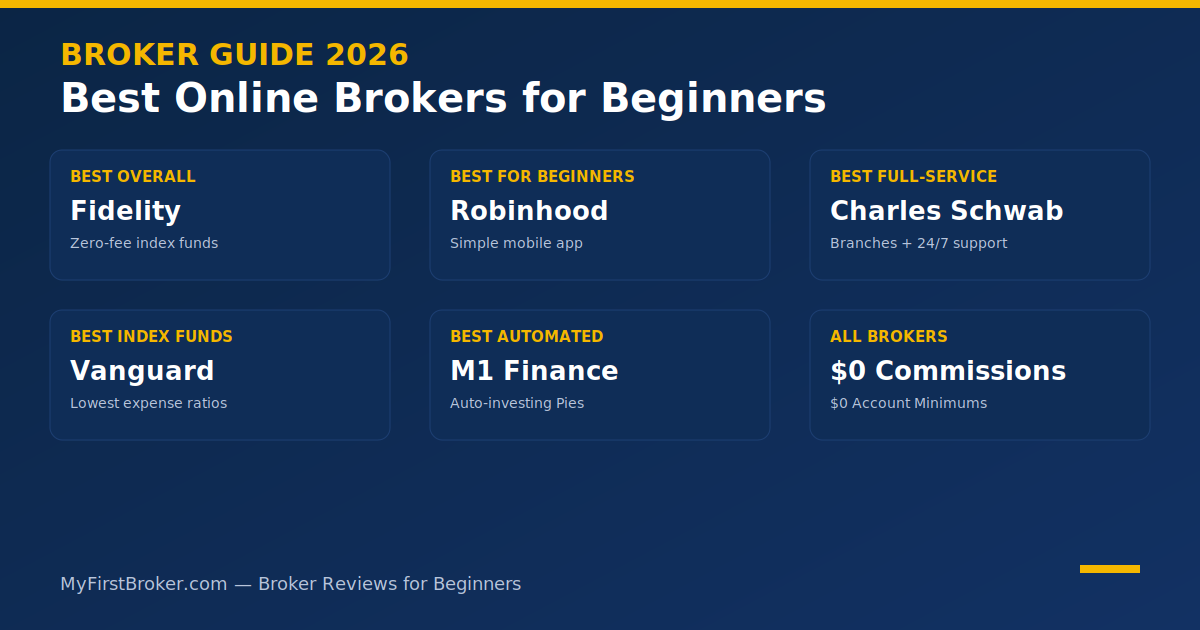
Best for mobile-first users: Robinhood — simple interface, great for casual investors.
Best for long-term retirement accounts: Vanguard — low-cost index funds, built for the long haul.
How We Evaluated Each Broker
To find the best online brokers for beginners, we rated each platform across five criteria that actually matter:
- Account minimum — Can you start with a small amount?
- Trading fees — Are there hidden costs?
- Ease of use — Can a non-expert navigate it?
- Educational resources — Does the platform help you learn?
- Investment selection — Stocks, ETFs, index funds, IRAs?
The 7 Best Online Brokers for Beginners in 2026
Fidelity Investments
- Account Minimum$0
- Stock/ETF Trades$0
- Fractional Shares✓ Yes (from $1)
- Retirement Accounts✓ IRA, Roth IRA
- Educational Tools✓ Excellent
Fidelity is the gold standard for beginners in 2026. Zero fees, zero minimum, fractional shares, and a learning center that’s genuinely useful.
Open Fidelity Account →Robinhood
- Account Minimum$0
- Stock/ETF Trades$0
- Fractional Shares✓ Yes
- Retirement Accounts✓ Roth IRA
- Educational Tools✗ Limited
Robinhood’s app is the simplest investing interface available. Great for casual investors who want to buy a few stocks or ETFs without complexity.
Open Robinhood Account →Charles Schwab
- Account Minimum$0
- Stock/ETF Trades$0
- Fractional Shares✓ Yes
- Retirement Accounts✓ Full suite
- Educational Tools✓ Very good
Schwab is a powerhouse with no minimum and excellent customer service you can reach by phone.
Open Schwab Account →Vanguard
- Account Minimum$0 (ETFs)
- Stock/ETF Trades$0
- Fractional Shares✗ ETFs only
- Retirement Accounts✓ IRA, Roth IRA
- Educational ToolsModerate
Vanguard invented the index fund. If your goal is long-term wealth building through low-cost index funds, Vanguard is built for that.
Open Vanguard Account →M1 Finance
- Account Minimum$0
- Platform Fee$3/mo if under $10,000 in assets (waived at $10k+)
- Stock/ETF Trades$0
- Fractional Shares✓ Yes
- Retirement Accounts✓ IRA
- Educational ToolsLimited
M1 Finance lets you build a “pie” portfolio and automate contributions. Perfect for beginners who want to invest on autopilot — just watch the $3/month fee if your balance stays under $10,000.
Open M1 Finance Account →SoFi Invest
- Account Minimum$0
- Stock/ETF Trades$0
- Fractional Shares✓ Yes
- Retirement Accounts✓ IRA + robo option
- Educational Tools✓ Good
SoFi Invest bundles $0-commission trading with banking and free access to certified financial planners — a strong pick for beginners who want investing and everyday banking under one login.
Open SoFi Invest Account →Acorns
- Account Minimum$5
- Stock/ETF TradesPre-built portfolios only
- Fractional SharesBuilt into every portfolio
- Retirement Accounts✓ IRA (Acorns Later)
- Educational ToolsModerate
Acorns automatically rounds up your everyday purchases and invests the spare change into a pre-built portfolio — the easiest possible on-ramp for someone who knows they won’t invest manually. Its flat monthly fee ($3–$12) is worth checking against your balance before signing up.
Open Acorns Account →Want more detail on any of these platforms? Read our full Fidelity Investments review, Robinhood review, Charles Schwab review, Vanguard review, M1 Finance review, SoFi Invest review, and Acorns review.
Quick Comparison Table
| Broker | Min. Deposit | Stock Fees | Fractional | Roth IRA | Education | ||||||
|---|---|---|---|---|---|---|---|---|---|---|---|
| Fidelity | $0 | $0 | ✓ | ✓ | Excellent | ||||||
| Robinhood | $0 | $0 | ✓ | ✓ | Limited | ||||||
| Charles Schwab | $0 | $0 | ✓ | ✓ | Very Good | ||||||
| Vanguard | $0 | $0 | ETFs only | ✓ | Moderate | M1 Finance | $0 | $0 ($3/mo under $10k) | ✓ | ✓ | Limited |
| SoFi Invest | $0 | $0 | ✓ | ✓ | Good | ||||||
| Acorns | $5 | Flat fee ($3–$12/mo) | Built-in | ✓ | Moderate |
What to Look For as a Beginner
1. No account minimum
In 2026, there’s no reason to use a broker that requires a minimum deposit. Every major platform on this list lets you open an account with $0.
2. Commission-free trading
Every reputable platform now charges $0 to buy or sell stocks and ETFs. If a broker still charges per trade, that’s a red flag.
3. Fractional shares
Fractional shares let you buy a piece of a stock for as little as $1. This is critical for beginners with limited starting capital.
4. SIPC insurance
Make sure your broker is SIPC-insured, which protects up to $500,000 of your assets. Every broker on this list qualifies.
How to Open a Brokerage Account
- Choose your broker — Use the comparisons above
- Visit the broker’s website and click “Open an Account”
- Enter your personal information — Name, address, SSN
- Choose account type — Taxable brokerage or Roth IRA
- Link your bank account via ACH transfer
- Make your first investment — A simple S&P 500 ETF like VOO or FXAIX
Frequently Asked Questions
What is the best broker for beginners with no money?
Fidelity is the best choice — open an account with $0 and buy fractional shares for as little as $1.
Is Robinhood safe for beginners?
Yes — Robinhood is SIPC-insured and regulated by FINRA. The main downside is the lack of educational content.
Should I open a brokerage account or a Roth IRA?
If investing for retirement, a Roth IRA is almost always better — your investments grow tax-free. You can contribute up to $7,000/year in 2026.
Can I use multiple brokers?
Yes, but it’s not necessary to start. Pick one, get comfortable, and expand later.
Is this best online brokers for beginners guide up to date?
Yes — this best online brokers for beginners guide is reviewed regularly and reflects current fees, minimums, and account features as of 2026.
Whichever platform you choose, all of these are among the best online brokers for beginners in 2026 — the right pick depends on whether you value simplicity, low-cost index funds, or full-service support.
For an unbiased overview of how brokerage accounts work, see the SEC’s official guide to opening a brokerage account at Investor.gov.