
ETF vs stocks is one of the first big decisions every beginner investor faces, and the data has a clear answer for most people — even though picking individual stocks feels more exciting. Understanding the real difference between the two can save you from years of underperformance chasing the wrong strategy.
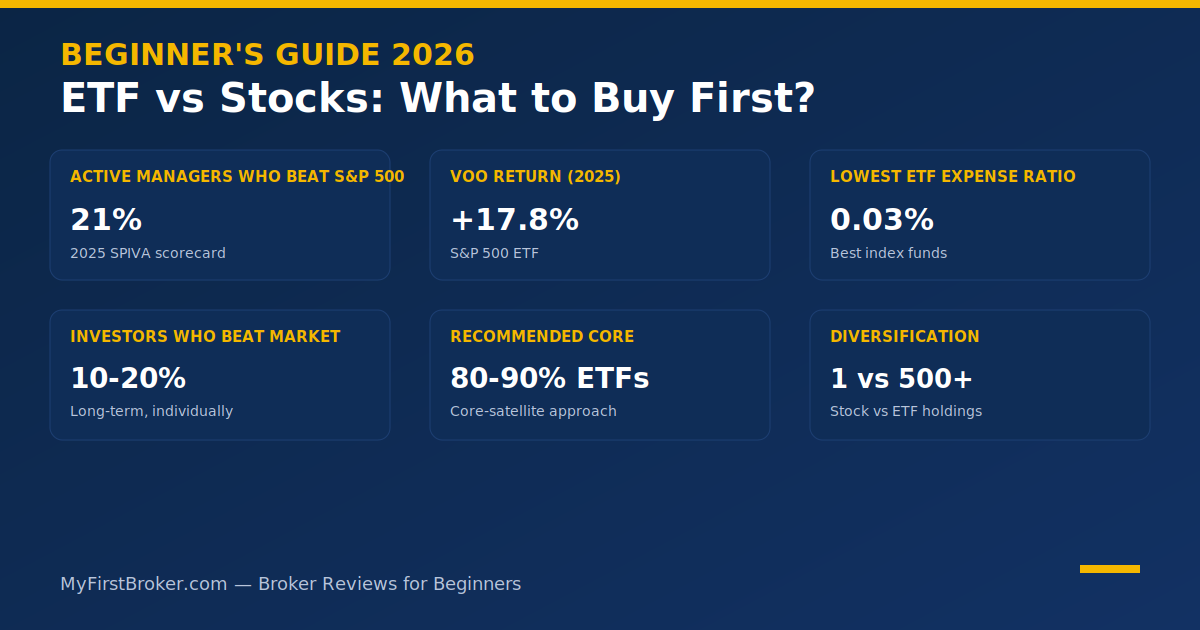
An ETF (Exchange-Traded Fund) bundles hundreds or thousands of stocks into one security, giving you instant diversification for a low annual fee. An individual stock gives you ownership in one company, with higher potential reward and higher risk. For most beginners, ETFs are the better starting point: in 2025, 79% of professional fund managers failed to beat the S&P 500, and most individual investors don’t either. A common approach is to build a portfolio mostly of low-cost ETFs, with a small portion set aside for individual stocks you want to research and follow.
ETF vs Stocks: The Core Difference
What you own: An ETF holds many companies; a stock is ownership in one company
Diversification: High with ETFs; low with individual stocks
Typical cost: ETFs charge a small annual expense ratio (as low as 0.03%); stocks have no ongoing fee once purchased
Risk: Lower with ETFs, since losses in one company are spread out; higher with individual stocks
Effort required: Minimal for ETFs; ongoing research and monitoring for individual stocks
Why Most Beginners Should Start with ETFs
The data is hard to ignore. According to the 2025 SPIVA scorecard, 79% of active large-cap fund managers underperformed the S&P 500 — professionals with research teams and years of experience. Academic research suggests only 10-20% of individual investors consistently beat the market over long periods. If trained professionals struggle to pick winning stocks consistently, a beginner starting out faces the same uphill battle. A simple S&P 500 ETF like VOO gained 17.8% in 2025 with essentially zero effort beyond buying and holding.
When Individual Stocks Make Sense
Individual stocks aren’t wrong for everyone — some investors genuinely enjoy researching companies, reading earnings reports, and building conviction in specific businesses. If that’s you, a common strategy is “core and satellite”: keep 80-90% of your portfolio in low-cost, diversified ETFs as your foundation, and use the remaining 10-20% for individual stocks you want to research and hold with real conviction. This way, your overall results aren’t dependent on picking winners, but you still get to participate in stock-picking if you enjoy it.
ETF vs Stocks: Side-by-Side Comparison
| Factor | ETFs | Individual Stocks |
|---|---|---|
| Diversification | High — hundreds/thousands of holdings | Low — single company |
| Ongoing cost | Small expense ratio (0.03%-0.20% typical) | $0 ongoing (commission-free brokers) |
| Volatility | Lower | Higher |
| Research needed | Minimal | Significant, ongoing |
| Upside potential | Matches the market | Can beat or badly lag the market |
How to Get Started
- Open a brokerage account if you haven’t already (see our step-by-step guide).
- Start with a broad-market ETF like an S&P 500 fund for your core holding.
- If you want to explore individual stocks, limit them to a small percentage of your total portfolio.
- Reinvest dividends and add contributions regularly rather than trying to time the market.
Frequently Asked Questions
Are ETFs safer than individual stocks?
Generally yes — because an ETF spreads your money across many companies, a decline in any single company has a much smaller impact on your overall investment compared to holding that company’s stock directly.
Can I lose money in an ETF?
Yes. ETFs still carry market risk — if the overall market or sector they track declines, the ETF’s value declines too. They’re lower-risk relative to individual stocks, not risk-free.
Should beginners only buy ETFs?
Not necessarily only, but predominantly. Many experienced investors recommend beginners build a core position in low-cost ETFs first, and only add individual stocks once they have a solid foundation and want to dedicate time to research.
Is this ETF vs stocks guide up to date?
Yes — this ETF vs stocks guide is reviewed regularly and reflects current market data and performance figures as of 2026.
Ready to open your first account? See our Best Online Brokers for Beginners roundup and our step-by-step guide to opening a brokerage account, or read Vanguard’s official guide to choosing between funds and individual securities.