
How to open a brokerage account is one of the first real steps toward investing, and the good news is that it’s simpler than most beginners expect — the entire process usually takes about 10 minutes online, with approval typically arriving within 1-2 business days. This guide walks through exactly what you’ll need and what to expect at each step.
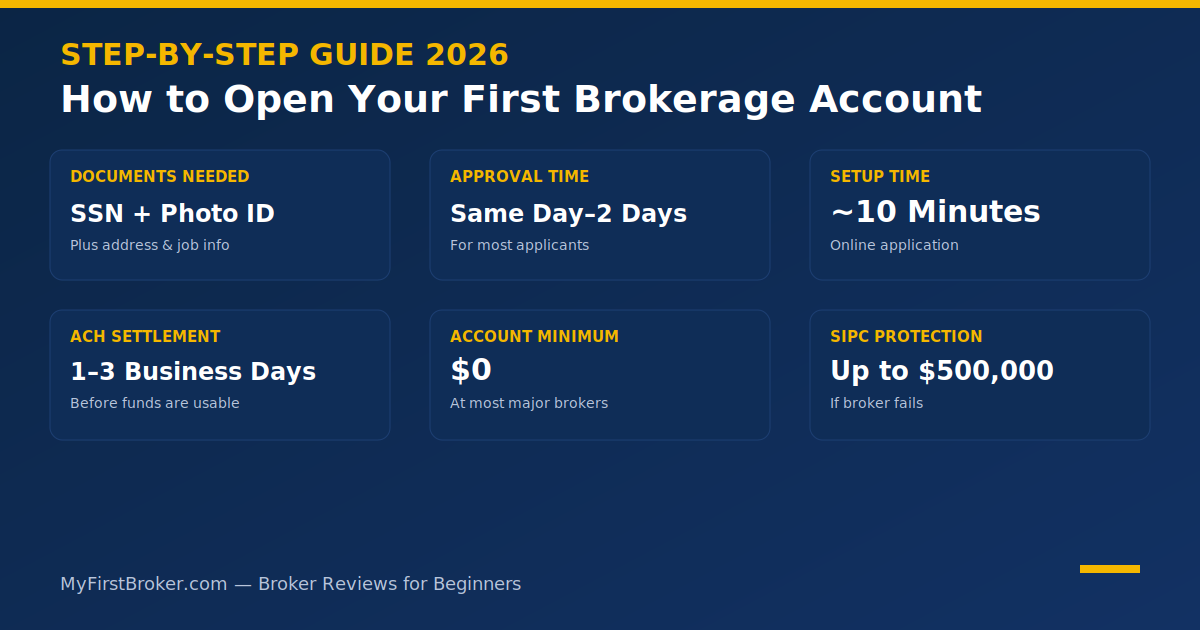
Opening a brokerage account requires your Social Security number, a government-issued photo ID, your address, employment information, and your bank account details to fund it. The broker is legally required to verify your identity (a process called KYC), which usually takes minutes online. Most beginners are approved the same day, with funds available to invest within 1-3 business days after an ACH transfer.
What You Need Before You Start
Social Security Number or ITIN: Required for tax reporting
Government-issued photo ID: Driver’s license or passport
Mailing address: Current residential address
Employment information: Employer name and status
Bank account details: Routing and account numbers, for funding via ACH
Why Brokers Ask So Many Questions: KYC Explained
When you apply, you’ll be asked about your income, investment experience, and risk tolerance. This isn’t just paperwork — it’s part of a legally required process called KYC (“Know Your Customer”), enforced by the SEC and FINRA. It verifies that you’re a real, identifiable person and helps the broker understand your risk profile before letting you trade. Every legitimate broker in the U.S. follows this process, so being asked these questions is a normal sign the broker is operating properly, not a red flag.
Step-by-Step: How to Open Your First Brokerage Account
- Choose your broker. Compare fees, account minimums, and available account types before applying.
- Start the online application. Most brokers let you begin this in a few minutes on their website or app.
- Choose your account type. A taxable individual brokerage account is the most common starting point; a Roth or Traditional IRA is worth considering if you’re investing for retirement.
- Enter your personal information. Name, address, SSN, employment details, and answers to the KYC questions about your investing experience and goals.
- Link your bank account. You’ll need your routing and account numbers to set up ACH funding.
- Submit and wait for approval. Most applications are approved the same day, though some take 1-2 business days if manual identity verification is needed.
- Fund your account. ACH transfers typically settle in 1-3 business days; wire transfers settle the same day but may involve a fee.
- Make your first investment. Once funds settle, you’re ready to buy your first stock, ETF, or fund.
Which Account Type Should You Open First?
If you’re not sure where to start, a common beginner sequence is: contribute to a 401(k) up to any employer match first (if available through work), then open a Roth IRA, then consider a Health Savings Account if you’re eligible, and only after that turn to a standard taxable brokerage account. This order prioritizes free employer money and tax-advantaged growth before taxable investing — though your own priorities (like needing access to the money sooner) may change what makes sense for you.
Is Your Money Protected?
Yes — legitimate U.S. brokers are members of SIPC (Securities Investor Protection Corporation), which protects up to $500,000 per account (including up to $250,000 in cash) if the brokerage itself fails. This doesn’t protect against investment losses from market movements, only against the brokerage going out of business.
Frequently Asked Questions
How long does it take to open a brokerage account?
The application itself usually takes about 10 minutes. Approval is typically same-day to 1-2 business days, and funds take an additional 1-3 business days to settle via ACH before you can invest them.
Do I need money to open a brokerage account?
Most major brokers, including Fidelity, Robinhood, and Charles Schwab, have no minimum deposit required to open an account.
Is opening a brokerage account safe?
Yes, as long as you use a broker that’s a member of SIPC and regulated by FINRA. Your identity is verified through a legally required KYC process, which protects both you and the broker from fraud.
Is this guide on how to open a brokerage account up to date?
Yes — this guide on how to open a brokerage account is reviewed regularly and reflects current requirements and processes as of 2026.
Ready to compare options? See our Best Online Brokers for Beginners roundup, our Fidelity Investments review, or read FINRA’s official guide to brokerage accounts.
Knowing how to open a brokerage account is the first real step toward investing — once you understand the process, opening additional accounts down the road becomes second nature.