
Fidelity vs Schwab is one of the most common matchups beginners face when comparing Fidelity Investments and Charles Schwab, since both are large, established brokers with $0 commissions, $0 account minimums, and a full lineup of account types. Once you look past the headline pricing, though, a few real differences emerge — and this comparison breaks them down so you can pick the one that actually fits how you plan to invest.
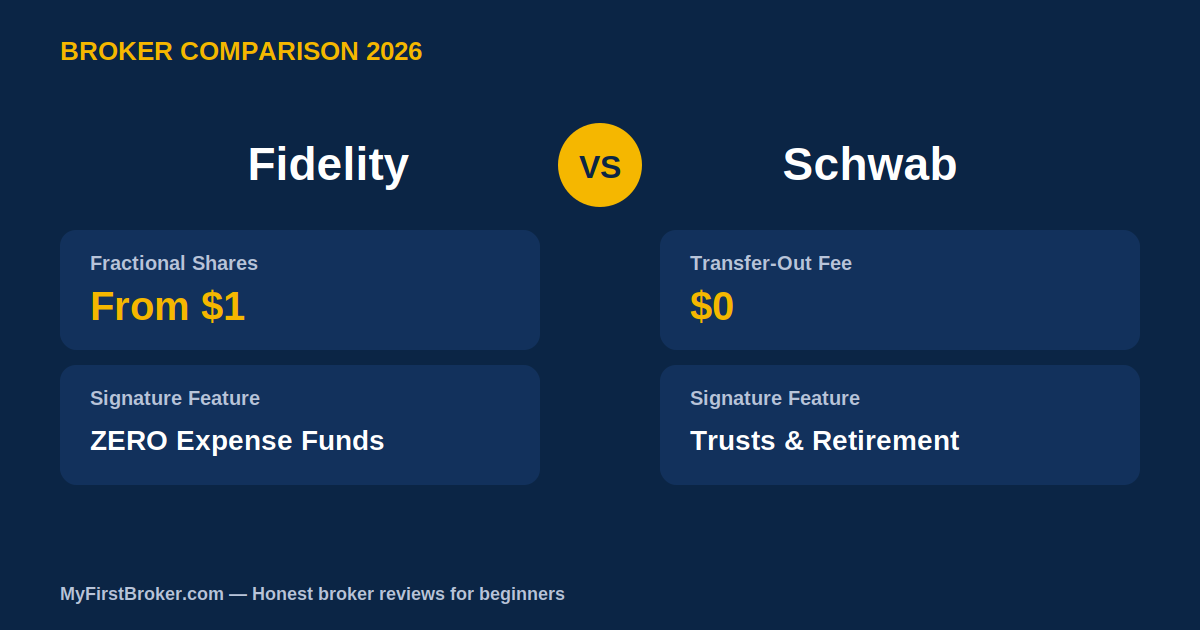
Both brokers are excellent, low-cost choices for beginners. Fidelity edges ahead for its proprietary zero-expense-ratio index funds and slightly lower fractional share threshold. Schwab edges ahead for its $0 fee to transfer your account elsewhere and its broader retirement and trust account options. For most beginners, either is a safe long-term home — the deciding factor usually comes down to small details covered below.
In short, the Fidelity vs Schwab decision comes down to your investing style rather than cost.
Fidelity Investments
- Account Minimum$0
- Stock/ETF Trades$0
- Fractional Shares✓ From $1
- Non-Proprietary Fund Fee$49.95
- Transfer-Out FeeStandard ACAT fee applies
- Signature FeatureZERO expense ratio index funds
Charles Schwab
- Account Minimum$0
- Stock/ETF Trades$0
- Fractional Shares✓ From $5 (Stock Slices)
- Non-OneSource Fund Fee$49.95
- Transfer-Out Fee$0
- Signature FeatureTrusts & retirement plan variety
Where Fidelity Wins
- Lower fractional share minimum: Fidelity lets you start with $1 per stock, versus Schwab’s $5 minimum through Stock Slices.
- Proprietary index funds: Fidelity’s ZERO fund lineup carries a 0% expense ratio — something Schwab doesn’t match with its own funds.
- Robo-advisor option: Fidelity Go is free for balances under $25,000, giving beginners a hands-off entry point without switching brokers.
Where Schwab Wins
- Free account transfers: Schwab charges $0 if you ever move your portfolio to a different broker (ACAT transfer). Fidelity’s standard transfer fee makes leaving slightly more expensive.
- Broader account types: Schwab offers more dedicated options for trusts and small-business retirement plans (SEP IRA, Solo 401(k)).
- No inactivity fee, ever: Both brokers avoid inactivity fees, but Schwab’s fee structure overall has slightly fewer edge cases where charges apply.
Still torn on Fidelity vs Schwab? If you value low-cost index funds, Fidelity edges ahead; if you value in-person support, Schwab does.
Which One Should You Choose?
Choose Fidelity if: you want the lowest possible fractional share minimum, you’re interested in Fidelity’s zero-expense-ratio index funds, or you might want a free robo-advisor option later without opening a new account.
Choose Schwab if: you value the flexibility to leave without a transfer fee, you expect to need a trust or small-business retirement account down the road, or you simply prefer Schwab’s platform and research tools.
Realistically, both brokers are strong enough that you won’t go wrong picking either one as your primary long-term account. Read our full Fidelity Investments review or Charles Schwab review for the complete fee breakdown of each.
Fees at a Glance: Fidelity vs Schwab
When it comes to day-to-day costs, Fidelity vs Schwab is nearly a tie. Both charge $0 for online stock and ETF trades, both waive account minimums entirely, and both charge $49.95 for mutual funds outside their respective no-fee lists. The gap only appears in less common situations: broker-assisted trades cost $32.95 at Fidelity versus $25 at Schwab, and moving your account elsewhere is free at Schwab but comes with Fidelity’s standard transfer fee.
Frequently Asked Questions
Is Fidelity or Schwab better for beginners?
Both are excellent for beginners thanks to $0 minimums and $0 commissions. Fidelity has a slight edge for very small fractional investments and free proprietary index funds; Schwab has a slight edge for account flexibility and fee-free transfers out.
Can I have accounts at both Fidelity and Schwab?
Yes. Many investors use one broker for a Roth IRA and another for a taxable brokerage account, or simply keep accounts open at both to compare tools over time.
Which has better customer service, Fidelity or Schwab?
Both offer 24/7 phone support and physical branch access in most major U.S. cities. Neither has a clear public advantage in support quality as of 2026.
Is this Fidelity vs Schwab comparison up to date?
Yes — this Fidelity vs Schwab comparison is reviewed regularly and reflects current fees, minimums, and account features as of 2026.
Curious how these two stack up against app-first alternatives? Check our Robinhood review or the full comparison of the best online brokers for beginners in 2026. For general investor protections that apply across U.S. brokers, see the Investor.gov guide to investing basics.