
Looking for an honest Robinhood review before you download the app? Robinhood built its reputation on commission-free trading and a dead-simple mobile interface — and in 2026, that reputation still mostly holds up. But “commission-free” doesn’t mean “cost-free,” and Robinhood works differently from full-service brokers like Fidelity in ways beginners should understand before opening an account.
Robinhood is the easiest broker on this list to get started with: $0 minimum, $0 commissions on stocks, ETFs, options, and crypto, and one of the simplest mobile apps available. The trade-offs are lighter educational content and fewer account types than Fidelity or Schwab — better for a first brokerage account than a long-term, all-in-one platform.
Open a Robinhood Account →
Opening an account is free. MyFirstBroker may earn a commission if you sign up through this link.
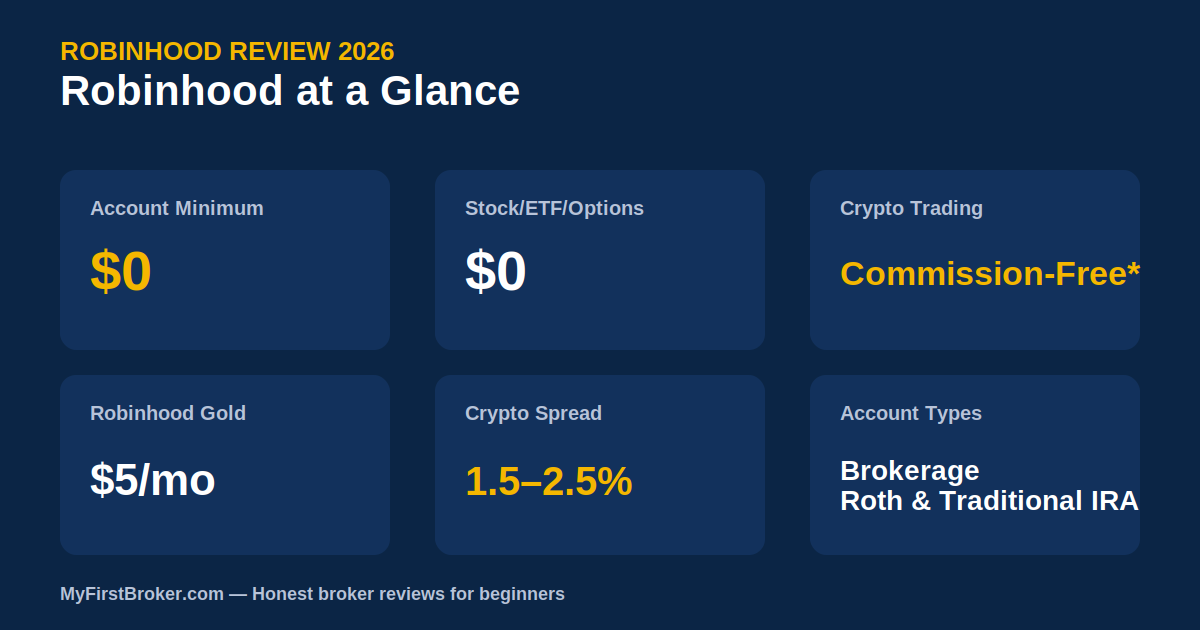
Robinhood at a Glance
- Account Minimum$0
- Stock/ETF Trades$0 commission
- Options Contracts$0.65 per contract (standard) / $0 with Gold
- Crypto Trading✓ Yes, commission-free (spread applies)
- Fractional Shares✓ Yes
- Account TypesBrokerage, Roth & Traditional IRA
- Robinhood Gold$5/month optional
Robinhood Review: How Much Does It Actually Cost?
This Robinhood review found pricing that’s genuinely simple for day-to-day use: $0 commissions on every stock, ETF, and options trade, no account minimums, and no annual maintenance fees. If you’re a beginner who buys and holds without margin or wire transfers, your realistic annual cost is close to $0.
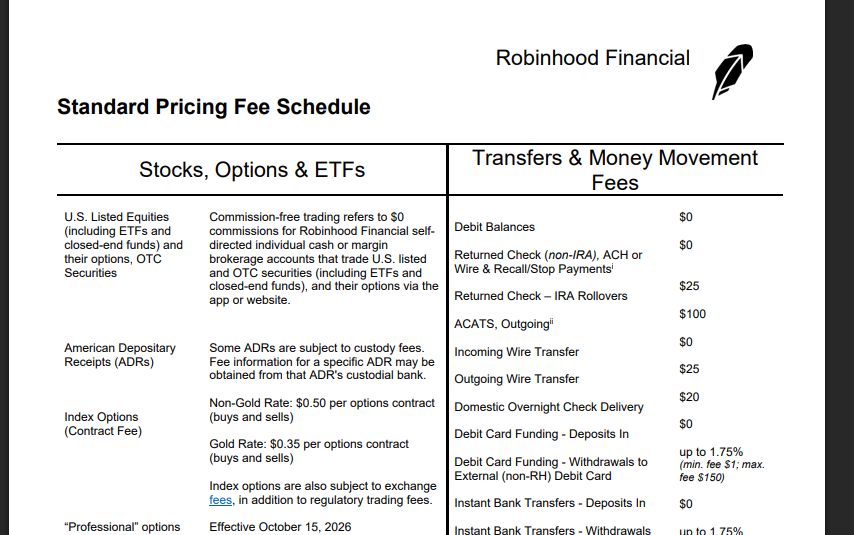
Where costs can appear:
- Robinhood Gold: An optional $5/month subscription that unlocks $0 options fees, a higher APY on uninvested cash, and an IRA matching bonus. Only worth it once your cash balance or trading volume justifies the fee.
- Crypto spread: Crypto trades are commission-free, but Robinhood earns roughly 1.5–2.5% on the buy/sell spread — this functions like a hidden fee, especially on larger trades.
- Wire transfers: $25 per outgoing wire. ACH transfers remain free, so most users never need to pay this.
- Account transfer-out fee: Moving your portfolio to another broker costs $75–$100, depending on the transfer type.
- Regulatory fees: Small, unavoidable SEC and FINRA fees apply to sell orders industry-wide — typically a few cents per trade, not something Robinhood controls or profits from directly.
Account Types Available
This is where Robinhood is noticeably more limited than Fidelity or Schwab. Robinhood currently offers:
- Individual Brokerage Account: The standard taxable account most users start with.
- Roth & Traditional IRA: Both available, with an IRA matching contribution for Robinhood Gold subscribers.
There’s no Cash Management Account, no 529 plan, no HSA, and no custodial accounts — so if you expect to need those account types soon, keep that in mind before committing long-term.
Pros and Cons
✓ Pros
- $0 account minimum
- $0 commissions on stocks, ETFs, options, and crypto
- Simplest, most beginner-friendly app interface on this list
- Fractional shares available
- IRA match available through Robinhood Gold
✗ Cons
- Limited account types (no 529, HSA, or Cash Management)
- Thinner educational content than Fidelity or Schwab
- Crypto spread functions as a hidden fee
- $75–$100 fee if you transfer your portfolio elsewhere
- No phone-based full-service support in the way traditional brokers offer
Who Is Robinhood Best For?
Robinhood makes the most sense for beginners who want the simplest possible way to buy their first stocks and ETFs, without navigating a dense platform. Its app is arguably the easiest starting point on this list for someone who has never opened a brokerage account before.
If you expect to eventually want retirement account variety, robust research tools, or in-person support, a broker like Fidelity may serve you better as your primary long-term account. Some beginners use Robinhood for its simplicity early on, then add a second account elsewhere as their needs grow.
How to Open a Robinhood Account
- Download the Robinhood app or visit their website and select “Sign Up.”
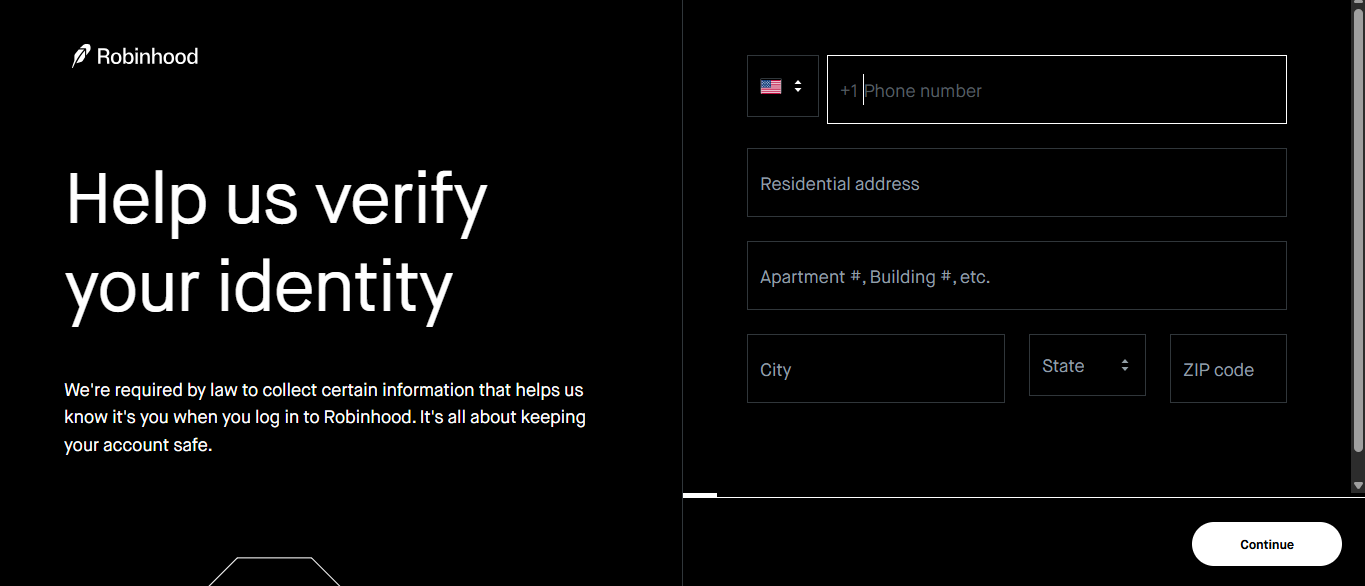
- Enter your personal information — name, address, Social Security number, and employment details.
- Verify your identity — Robinhood typically asks for a photo ID and may take several business days to complete verification.
- Link your bank account via ACH transfer to fund it.
- Make your first trade — many beginners start with a broad-market ETF or a small fractional share purchase.
Frequently Asked Questions
Is Robinhood safe for beginners?
How Does Robinhood Compare to Other Brokers?
Curious how Robinhood stacks up against other options? See our head-to-head comparisons: Robinhood vs Fidelity, Robinhood vs M1 Finance, and Robinhood vs SoFi.
Robinhood is a member of SIPC, which protects securities up to $500,000 per account in the event of broker failure (this doesn’t protect against market losses). It’s regulated by the SEC and FINRA like other major U.S. brokers.
Does Robinhood have hidden fees?
Most day-to-day trading is genuinely free. The costs to watch for are the crypto spread, wire transfer fees, and the transfer-out fee if you close your account and move elsewhere.
Is Robinhood good for long-term investing?
It can be, especially for stocks, ETFs, and IRAs. However, beginners planning to use multiple account types (like an HSA or 529) will eventually need a broker that offers them, since Robinhood currently doesn’t.
Is this Robinhood review up to date?
Yes. This Robinhood review reflects fees and features confirmed as of mid-2026. Fee schedules can change, so always confirm current details on Robinhood’s official fee schedule before opening an account.
Curious how Robinhood stacks up against a full-service broker? Read our full Fidelity Investments review or check our comparison of the best online brokers for beginners in 2026.
For an unbiased look at investor protections, see the SEC’s official guide to opening a brokerage account at Investor.gov.
Open a Robinhood Account →
Opening an account is free. MyFirstBroker may earn a commission if you sign up through this link.