
M1 Finance vs Robinhood is a common matchup for beginners choosing between two very different approaches to investing: M1’s automated, hands-off “Pie” system versus Robinhood’s real-time, hands-on trading app. Both charge $0 commissions, but the right choice depends heavily on how involved you want to be in managing your own portfolio.
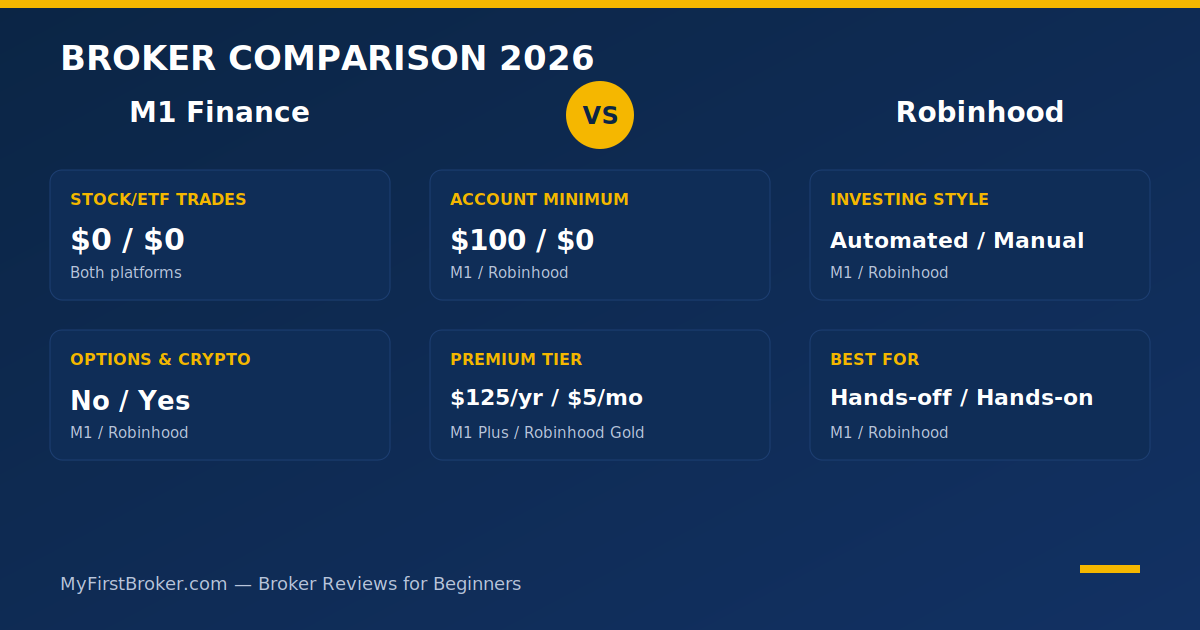
Both M1 Finance and Robinhood charge $0 for stock and ETF trades. M1 Finance is built for hands-off, long-term investors who want to set a target allocation and let automation handle the rebalancing. Robinhood is built for hands-on investors who want real-time trading, options, and crypto access. If you want to “set it and forget it,” M1 Finance fits better. If you want active control over individual trades, Robinhood is the stronger fit.
M1 Finance vs Robinhood at a Glance
Stock/ETF commissions: $0 at both platforms
Account minimum: $100 at M1 Finance vs $0 at Robinhood
Investing style: Automated “Pie” portfolios at M1 vs real-time manual trading at Robinhood
Options and crypto: Not the focus at M1 vs available at Robinhood
Premium tier: M1 Plus ($125/year) vs Robinhood Gold ($5/month)
How M1 Finance’s “Pie” System Works
M1 Finance lets you build a portfolio of stocks and ETFs organized into a “Pie,” where you assign each holding a target percentage. From there, M1 automates buying, selling, and rebalancing to keep your portfolio aligned with those percentages — ideal for investors who want to set a strategy once and let it run with minimal ongoing effort.
How Robinhood’s Approach Differs
Robinhood is built around real-time, individual trades. You choose exactly what to buy and sell, when to do it, and can access options and cryptocurrency trading directly in the same app — features that go beyond what M1 Finance is built for. This makes Robinhood a better fit for investors who want direct control over each transaction rather than an automated target allocation.
Which One Should You Choose?
If you want to pick your holdings, set target percentages, and let automation handle the ongoing management, M1 Finance is designed exactly for that. If you want to place trades yourself, explore options or crypto, and stay actively involved in day-to-day decisions, Robinhood fits that style better. Neither approach is wrong — it comes down to how hands-on you want to be.
M1 Finance Pros
- Automated portfolio rebalancing via “Pies”
- No trading commissions or advisory fees
- Good fit for long-term, hands-off investors
M1 Finance Cons
- $100 account minimum
- Not built for options or crypto trading
- M1 Plus premium costs $125/year
Robinhood Pros
- $0 account minimum
- Real-time, hands-on trading control
- Options and crypto trading available
Robinhood Cons
- No automated portfolio rebalancing
- Easier to make impulsive, less strategic trades
- $75 fee to transfer your account out
Frequently Asked Questions
Is M1 Finance or Robinhood better for beginners?
It depends on your style. M1 Finance suits beginners who want a hands-off, automated approach. Robinhood suits beginners who want to actively place trades and learn by doing.
Does M1 Finance charge trading fees?
No. M1 Finance charges $0 in trading commissions, similar to Robinhood, though it does offer an optional $125/year M1 Plus membership for additional features.
Can I trade options on M1 Finance?
M1 Finance is primarily built around automated stock and ETF portfolios rather than options trading. Robinhood offers direct options access if that’s a priority for you.
Is this M1 Finance vs Robinhood comparison up to date?
Yes — this M1 Finance vs Robinhood comparison is reviewed regularly and reflects current fees and features as of 2026.
For more, read our full M1 Finance review and Robinhood review, or see our Robinhood vs Fidelity comparison for another angle on Robinhood’s strengths and weaknesses.
For an unbiased overview of investor protections, see the SEC’s official guide to opening a brokerage account at Investor.gov.