
Robinhood vs Fidelity is a common question for beginners choosing between a mobile-first trading app and a full-service brokerage, since both now offer $0 commissions and $0 account minimums. The real differences show up in retirement accounts, research tools, and what happens to your uninvested cash — and this comparison breaks all of that down.
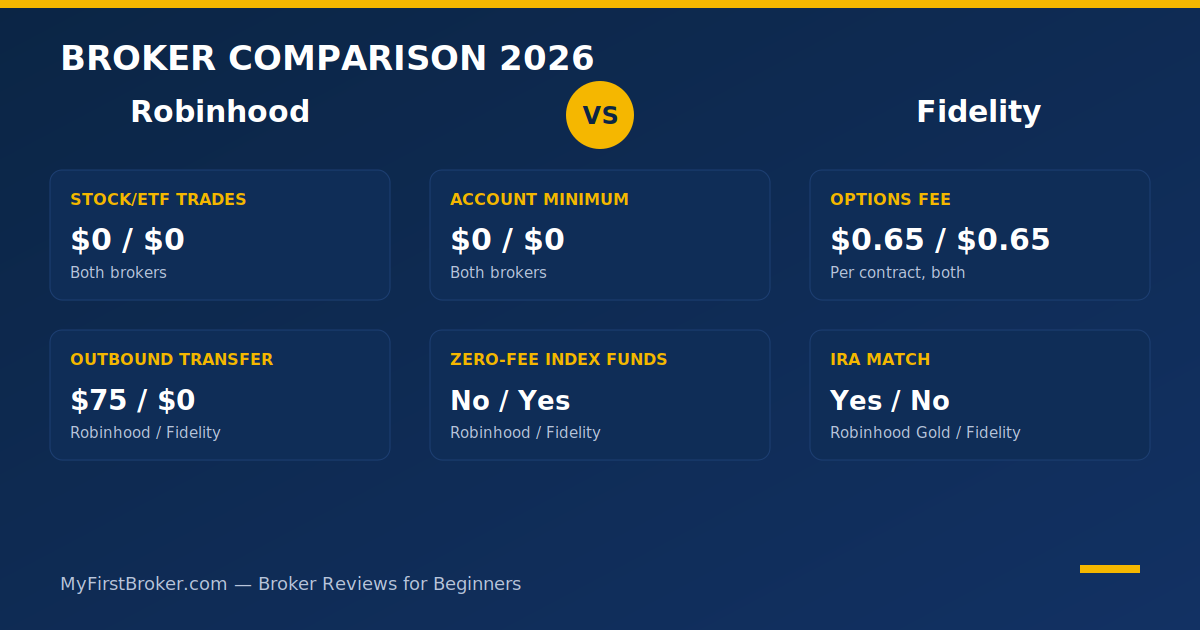
Both brokers charge $0 for stock and ETF trades with no account minimums. Fidelity edges ahead for long-term investors thanks to its zero-expense-ratio index funds, deeper research tools, and $0 outbound transfer fee. Robinhood edges ahead for simplicity, a cleaner mobile app, and its IRA match program. If you want one account for everything — investing, retirement, and cash management — Fidelity is the stronger long-term home. If you want the fastest, simplest way to start trading, Robinhood wins on ease of use.
Robinhood vs Fidelity at a Glance
Stock/ETF commissions: $0 at both brokers
Account minimum: $0 at both brokers
Options fee: $0.65 per contract at both (waived with Robinhood Gold)
Outbound transfer fee: $0 at Fidelity vs $75 at Robinhood
Retirement accounts: Full IRA lineup at Fidelity vs Robinhood Retirement (Traditional/Roth IRA with match) at Robinhood
Index funds: Fidelity offers proprietary zero-expense-ratio funds; Robinhood does not offer its own funds
Robinhood vs Fidelity: Costs and Fees Breakdown
Trading costs are essentially tied. Both brokers charge $0 for online stock and ETF trades and $0.65 per options contract. The real cost differences show up outside of day-to-day trading. Fidelity does not charge a fee to transfer your account to another broker, while Robinhood charges $75 for an outbound transfer. Robinhood Gold, an optional $5/month subscription, unlocks a 3% match on Robinhood Retirement contributions, a higher APY on uninvested cash, and access to margin — but it’s an added cost that Fidelity doesn’t require you to pay for comparable features.
Where Fidelity Wins
Fidelity’s biggest advantage for long-term investors is its lineup of proprietary index funds, including several with a 0% expense ratio — funds like this can save meaningful money over decades of investing. Fidelity also offers deeper research tools, a full range of account types (including 529 plans and health savings accounts), and $0 to transfer your account out if you ever switch brokers. For beginners who want a single account that can grow with them from a first taxable account into retirement accounts, Fidelity is built for that.
Where Robinhood Wins
Robinhood’s advantage is simplicity. The app is built around a clean, mobile-first interface that makes buying your first fractional share fast and approachable. Robinhood Retirement also offers a matching contribution on IRA deposits, which is unusual for a self-directed broker and can add real value for beginners who are just starting to save for retirement. Still torn on Robinhood vs Fidelity? If you value zero-cost index funds and deeper account options, Fidelity edges ahead; if you value a simple app and an IRA match, Robinhood does.
Fidelity Pros
- Zero-expense-ratio index funds
- $0 outbound transfer fee
- Full account lineup (529s, HSAs, more)
- Deeper research and trading tools
Fidelity Cons
- Interface is less streamlined for absolute beginners
- $49.95 fee on some non-NTF mutual funds
Robinhood Pros
- Simple, beginner-friendly mobile app
- IRA match through Robinhood Retirement
- Fast account opening and funding
Robinhood Cons
- $75 fee to transfer your account out
- No proprietary index funds
- Fewer account types overall
Who Is Robinhood vs Fidelity Best For?
Choose Fidelity if you want a long-term home for investing and retirement savings, access to $0-fee index funds, and the flexibility to open IRAs, HSAs, or custodial accounts down the road. Choose Robinhood if you want the simplest possible way to start investing with a small amount of money and don’t mind paying $5/month later for extra perks like the IRA match.
How to Open an Account: Robinhood vs Fidelity
- Go to Robinhood.com or Fidelity.com and select “Open an Account.”
- Choose your account type (individual brokerage, Roth IRA, Traditional IRA).
- Provide your Social Security number, employment information, and basic financial details.
- Link a bank account and fund with any amount — both brokers support fractional shares.
- Place your first trade once funds settle (usually 1-3 business days for ACH transfers).
Frequently Asked Questions
Is Robinhood or Fidelity better for beginners?
Both work well for beginners thanks to $0 minimums and commissions. Robinhood is simpler for a first trade; Fidelity is stronger if you plan to also open retirement or specialty accounts.
Can I have accounts at both Robinhood and Fidelity?
Yes. Many investors use Robinhood for a simple taxable account and Fidelity for retirement accounts, or vice versa.
Which has lower fees, Robinhood or Fidelity?
Day-to-day trading costs are the same. Fidelity has the edge on total cost if you ever transfer your account elsewhere, since Robinhood charges $75 for that and Fidelity charges $0.
Is this Robinhood vs Fidelity comparison up to date?
Yes — this Robinhood vs Fidelity comparison is reviewed regularly and reflects current fees, minimums, and account features as of 2026.
For more on how brokerage accounts are protected, see our Fidelity Investments Review and read the SEC’s official brokerage account guide at Investor.gov.