
Vanguard vs Fidelity is a classic matchup for long-term investors, since both brokers built their reputation on low-cost index funds rather than flashy trading tools. The differences that matter aren’t in trading commissions — they’re both $0 — but in account fees, fund minimums, and how each broker handles fractional investing.
Both brokers charge $0 for stock and ETF trades with no account minimum to open. Fidelity edges ahead for beginners with less capital, thanks to $1 fractional shares, a $0 outbound transfer fee, and zero-expense-ratio index funds with no minimum investment. Vanguard edges ahead for investors ready to commit $3,000+ to a mutual fund, since its Admiral Shares carry some of the lowest expense ratios in the industry. If you’re just starting out with a small amount, Fidelity is the easier on-ramp. If you’re building a long-term index portfolio with a larger lump sum, Vanguard is built for exactly that.
Vanguard vs Fidelity at a Glance
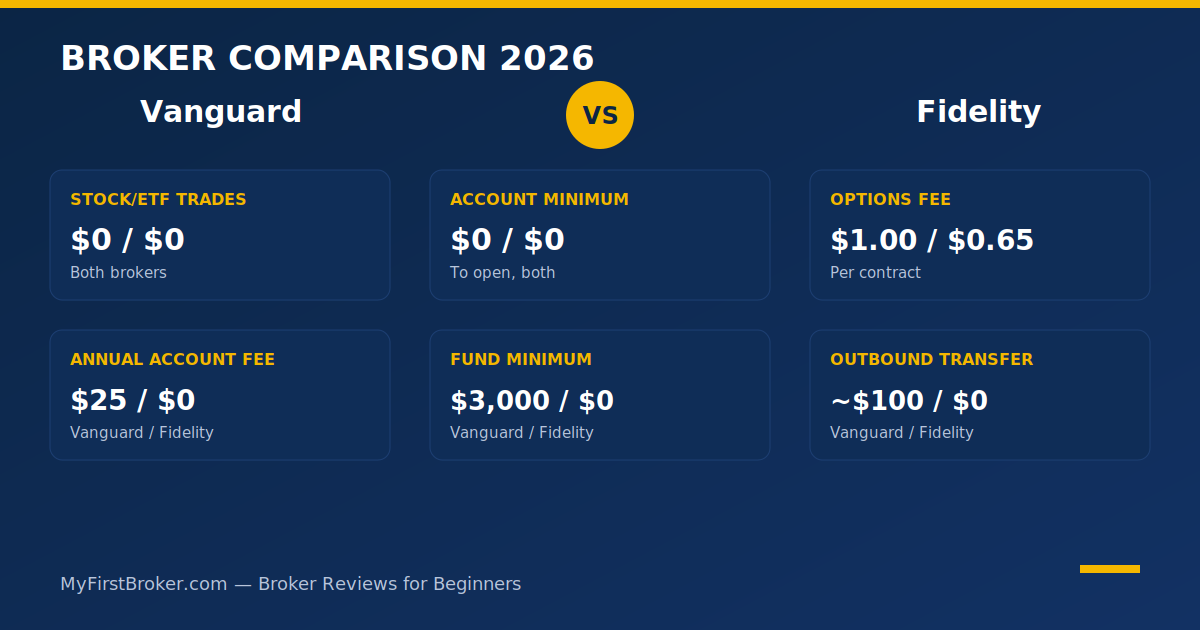
Stock/ETF commissions: $0 at both brokers
Account minimum: $0 to open at both brokers
Options fee: $1.00/contract at Vanguard vs $0.65/contract at Fidelity
Annual account fee: $25 at Vanguard (waivable with e-delivery) vs $0 at Fidelity
Mutual fund minimum: $3,000 for most Vanguard index funds vs $0 for Fidelity ZERO funds
Outbound transfer fee: Around $100 at Vanguard vs $0 at Fidelity
Vanguard vs Fidelity: Costs and Fees Breakdown
Trading costs are close but not identical. Both charge $0 for online stock and ETF trades, but Vanguard charges $1.00 per options contract compared to Fidelity’s $0.65. The bigger gap is in account-level fees: Vanguard charges a $25 annual service fee per brokerage account, though it’s easy to waive by signing up for electronic document delivery. Fidelity charges no such fee at all. Vanguard’s mutual funds also typically require a $3,000 initial investment for Admiral Shares, while Fidelity’s own index funds — including several with a 0% expense ratio — have no minimum investment.
Where Vanguard Wins
Vanguard’s core strength is fund quality at scale. Its average mutual fund expense ratio sits around 0.08%, and flagship funds like the Vanguard Total Stock Market ETF charge as little as 0.03% — a genuinely tiny cost on a large, long-term balance. For investors who already have $3,000 or more to commit and want a “buy it and forget it” index fund, Vanguard’s lineup is hard to beat.
Where Fidelity Wins
Fidelity’s advantage is accessibility. There’s no fund minimum standing between a beginner and index investing — its zero-expense-ratio funds can be started with $1 through fractional shares. Fidelity also charges no annual account fee and no fee to transfer your account elsewhere, removing two costs Vanguard investors need to actively manage. Still torn on Vanguard vs Fidelity? If you’re starting small, Fidelity removes more friction; if you’re investing a larger lump sum for the long term, Vanguard’s fund costs are tough to beat.
Vanguard Pros
- Extremely low expense ratios on flagship index funds
- No fee on standard IRAs with e-delivery
- Deep lineup of retirement-focused funds
Vanguard Cons
- $3,000 minimum on most mutual funds
- $25 annual brokerage account fee (unless waived)
- Dated website and app compared to newer platforms
Fidelity Pros
- Zero-expense-ratio index funds with no minimum
- Fractional shares from $1
- $0 annual fee and $0 outbound transfer fee
Fidelity Cons
- No proprietary ETF as widely tracked as Vanguard’s flagships
- $49.95 fee on some non-NTF mutual funds
Who Is Vanguard vs Fidelity Best For?
Choose Vanguard if you already have a few thousand dollars to invest in a single fund and want some of the lowest expense ratios available. Choose Fidelity if you’re starting with a small amount, want to avoid any account fees, or want the flexibility of fractional shares and $0-fee index funds.
How to Open an Account: Vanguard vs Fidelity
- Go to Vanguard.com or Fidelity.com and select “Open an Account.”
- Choose your account type (individual brokerage, Roth IRA, Traditional IRA).
- Provide your Social Security number, employment information, and basic financial details.
- Link a bank account and fund your account.
- At Vanguard, sign up for e-delivery immediately to avoid the $25 fee; at Fidelity, this step isn’t necessary since there’s no annual fee.
Frequently Asked Questions
Is Vanguard or Fidelity better for beginners?
Fidelity is generally easier for beginners with less capital, thanks to $1 fractional shares and no account fees. Vanguard is a strong choice once you have $3,000+ to invest in a single index fund.
Does Vanguard or Fidelity charge an account fee?
Vanguard charges a $25 annual account service fee, waivable by signing up for electronic document delivery. Fidelity charges no annual account fee at all.
Can I have accounts at both Vanguard and Fidelity?
Yes. Many investors hold long-term index funds at Vanguard while using Fidelity for everyday trading, fractional shares, or cash management.
Is this Vanguard vs Fidelity comparison up to date?
Yes — this Vanguard vs Fidelity comparison is reviewed regularly and reflects current fees, minimums, and account features as of 2026.
For more, read our full Vanguard review and Fidelity Investments review, or see the SEC’s official guide to opening a brokerage account at Investor.gov.