
Looking for an honest Vanguard review before opening an account? Vanguard invented the index fund, and its rock-bottom expense ratios are still the main reason beginners consider it in 2026. But Vanguard’s account fees and mutual fund minimums work differently than Fidelity or Schwab, and understanding those differences before you sign up can save you real money.
Vanguard is best for beginners focused specifically on long-term, low-cost index investing — its expense ratios are hard to beat anywhere. The account itself has a $0 minimum, but a $25 annual service fee applies unless you enroll in e-delivery, and many of its classic index mutual funds require a $3,000 minimum (ETFs don’t have this issue). It’s a stronger fit for buy-and-hold investors than for beginners who want a flashy app experience.
Open a Vanguard Account →
Opening an account is free. MyFirstBroker may earn a commission if you sign up through this link.
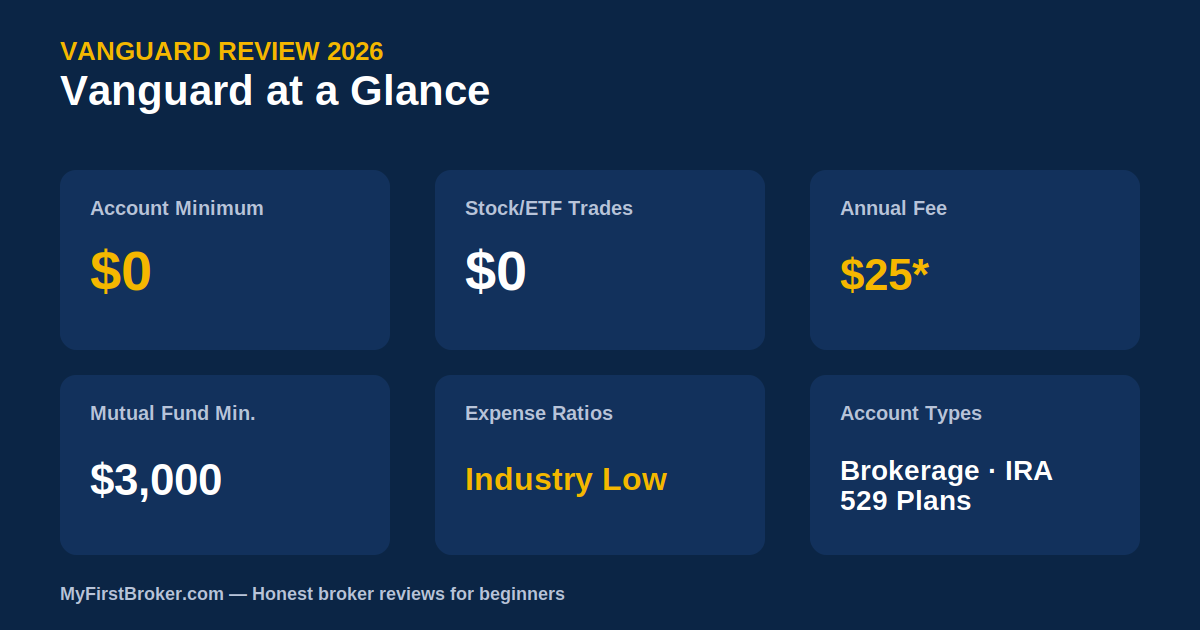
Vanguard at a Glance
- Account Minimum$0 (brokerage account itself)
- Stock/ETF Trades$0 commission online
- Annual Account Service Fee$25 (waived with e-delivery)
- Mutual Fund MinimumTypically $3,000 (Admiral Shares)
- Fractional Shares✗ ETFs only, not individual stocks
- Account TypesBrokerage, Roth & Traditional IRA, 529
- Broker-Assisted Trade Fee$25
Vanguard Review: How Much Does It Actually Cost?
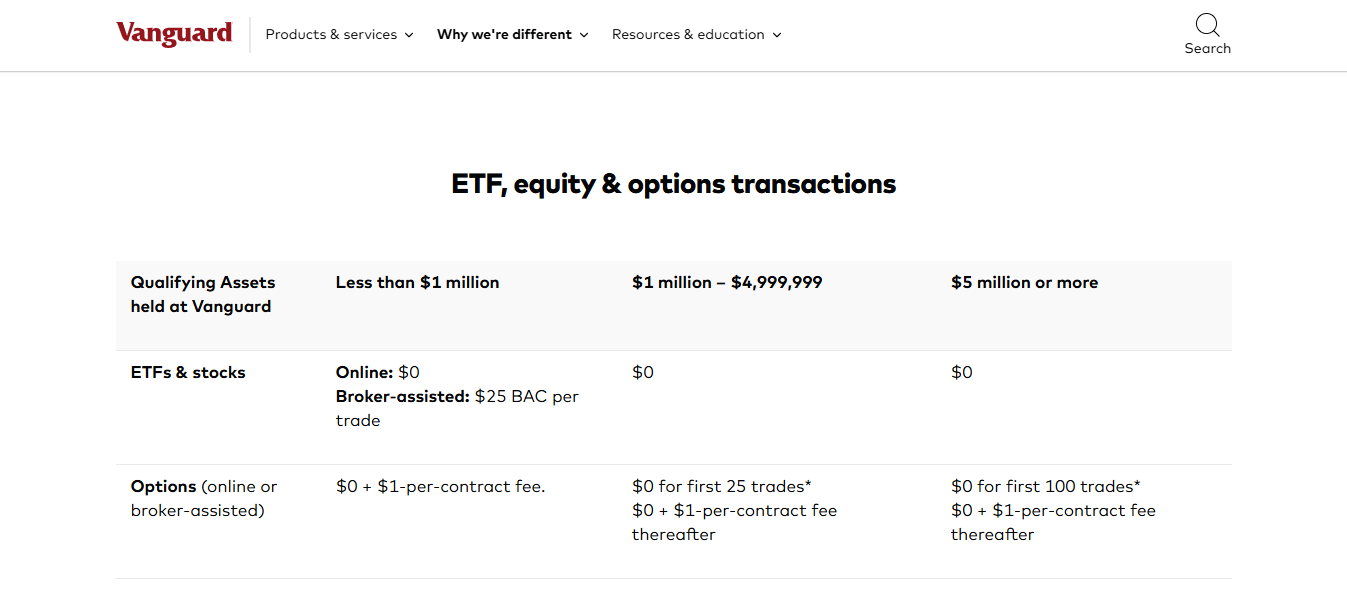
This Vanguard review found a pricing structure that rewards buy-and-hold investors but can surprise beginners who don’t read the fine print. Opening the brokerage account itself is free, and online stock and ETF trades cost $0 in commissions — consistent with the rest of the industry in 2026.
Where costs can appear:
- $25 annual account service fee: Charged per brokerage account unless you enroll in electronic delivery of statements and documents — a two-minute signup that eliminates the fee entirely. It’s also waived automatically for clients with very high account balances.
- $3,000 mutual fund minimums: Many of Vanguard’s classic index mutual funds (Admiral Shares) require a $3,000 minimum investment. This doesn’t apply to Vanguard’s ETF versions of the same funds, which trade like stocks with no minimum beyond the share price.
- Broker-assisted trades: $25 to place a trade over the phone with a representative, versus free online.
- Outgoing wire transfers: Typically around $10, waived for clients with very high balances. ACH transfers remain free.
The simplest way to avoid nearly every fee on this list: enroll in e-delivery immediately after opening your account, and choose Vanguard’s ETFs instead of the mutual fund versions if you’re starting with less than $3,000.
For the complete, most current breakdown, you can always check Vanguard’s official fee schedule.
Account Types Available
- Brokerage Account: Standard taxable account for general investing.
- Roth & Traditional IRA: Both available, with no separate account fee when enrolled in e-delivery.
- 529 College Savings Plan: Additional investments into 529 plans start at just $50.
Vanguard doesn’t offer the same breadth of account types as Fidelity or Schwab — there’s no Cash Management Account or HSA — so investors needing those will need a second account elsewhere.
Pros and Cons
✓ Pros
- Industry-leading low expense ratios on Vanguard funds and ETFs
- $0 commissions on stocks and ETFs
- $0 minimum to open the brokerage account
- No inactivity fee
- Strong reputation for long-term, buy-and-hold investing
✗ Cons
- $25 annual fee unless you enroll in e-delivery
- $3,000 minimum on many classic index mutual funds
- No fractional shares for individual stocks
- Fewer account types than Fidelity or Schwab
- Interface feels dated compared to app-first competitors
Who Is Vanguard Best For?
Vanguard is a strong fit for beginners whose main goal is long-term wealth building through low-cost index funds — not frequent trading, individual stock picking, or a polished mobile app. If your plan is to invest consistently in a broad-market ETF or index fund and largely leave it alone for years, Vanguard’s expense ratios are hard to beat.
How Does Vanguard Compare to Other Brokers?
Curious how Vanguard stacks up against other options? See our head-to-head comparisons: Vanguard vs Fidelity, Vanguard vs Schwab, Vanguard vs Robinhood, Vanguard vs SoFi, Vanguard vs Acorns, and Vanguard vs M1 Finance.
If you want fractional shares on individual stocks or a wider range of account types like a Cash Management Account, Fidelity or Charles Schwab may be a better fit as your primary account.
How to Open a Vanguard Account
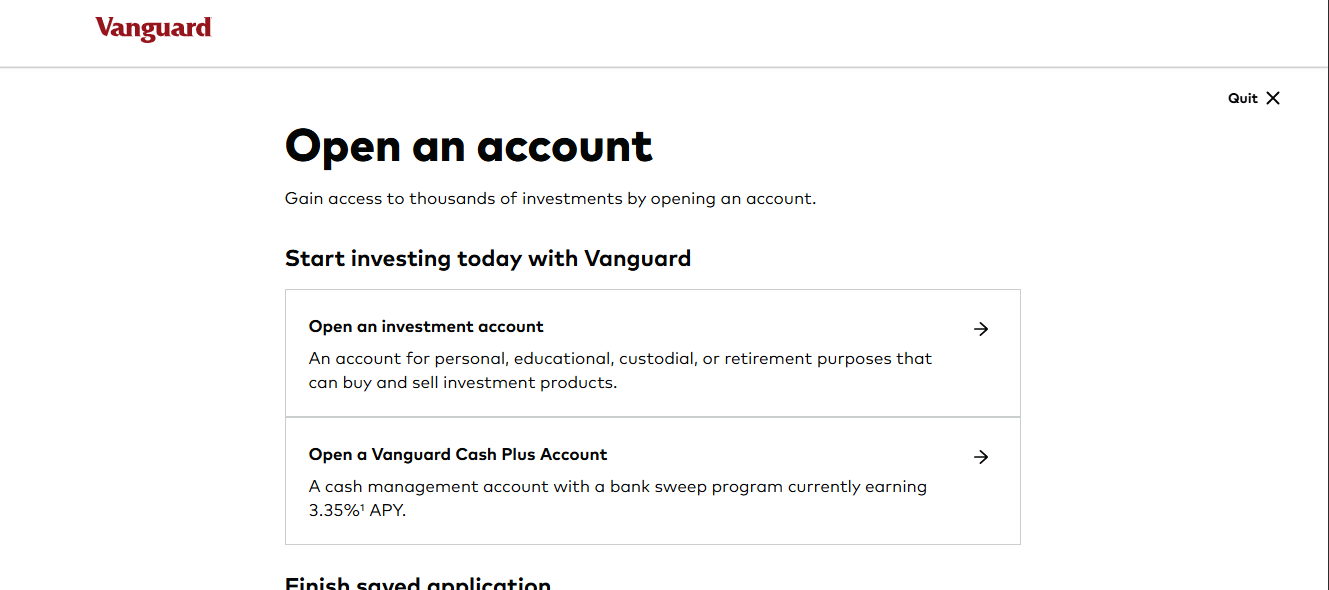
- Go to Vanguard’s website and select “Open an Account.”
- Choose your account type — a brokerage account or Roth IRA are common starting points for beginners.
- Enter your personal information — name, address, Social Security number, and employment details.
- Link your bank account via ACH transfer to fund it.
- Enroll in e-delivery right away to avoid the $25 annual fee.
- Make your first investment — many beginners start with a broad-market ETF like VOO or VTI, which have no fund minimum beyond the share price.
Frequently Asked Questions
Does Vanguard have a minimum deposit?
The brokerage account itself has no minimum to open. However, many of Vanguard’s classic index mutual funds require a $3,000 minimum — this doesn’t apply if you buy the ETF version instead.
How do I avoid Vanguard’s annual fee?
Enroll in electronic delivery of statements, confirmations, and other documents. This takes about two minutes and eliminates the $25 annual account service fee. For general investor protections that apply across all U.S. brokers, see the Investor.gov guide to investing basics.
Does Vanguard charge inactivity fees?
No. Vanguard does not charge a fee for leaving an account idle.
Is this Vanguard review up to date?
Yes. This Vanguard review reflects fees and features confirmed as of mid-2026. Fee schedules can change, so always confirm current details in Vanguard’s official fee schedule before opening an account.
Want to compare Vanguard to other platforms? Read our Fidelity Investments review, our Charles Schwab review, or check the full comparison of the best online brokers for beginners in 2026.
Open a Vanguard Account →
Opening an account is free. MyFirstBroker may earn a commission if you sign up through this link.