
What is a stock split? It’s when a company divides its existing shares into a larger number of shares, lowering the price per share while keeping the total value of your investment exactly the same. It sounds like it should change something meaningful, but a stock split is mostly a cosmetic corporate action — and understanding why companies do it can help you avoid overreacting to the news.
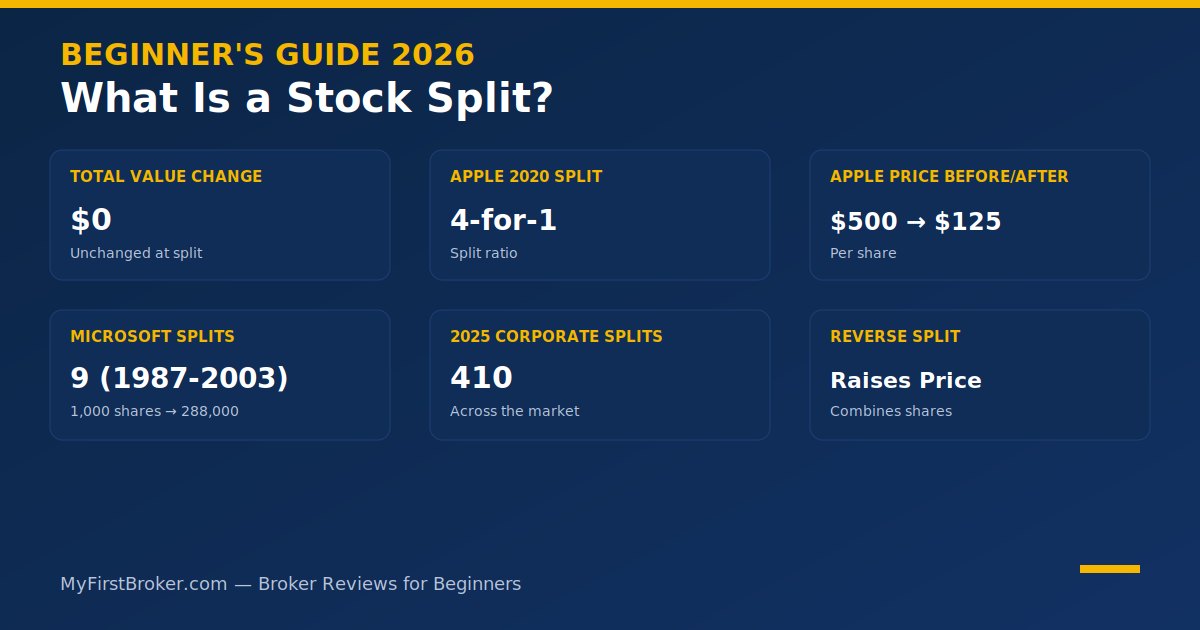
A stock split increases the number of a company’s outstanding shares while proportionally lowering the price per share, leaving your total investment value and ownership percentage completely unchanged. Companies do this mainly to make shares more affordable and accessible to retail investors, not to raise money or change their underlying business value. A 2-for-1 split, for example, doubles your share count while halving the price per share.
What Is a Stock Split and How Does It Work?
In a stock split, a company issues additional shares to existing shareholders based on a ratio, such as 2-for-1 or 4-for-1. If you owned 10 shares of a $200 stock before a 2-for-1 split, you’d own 20 shares worth $100 each afterward — same total value, more shares, lower price per share. The company’s actual business value, revenue, and earnings don’t change at all.
Why Do Companies Split Their Stock?
Affordability: A lower share price makes it easier for retail investors to buy in
Liquidity: More outstanding shares can narrow the bid-ask spread and increase trading activity
Psychological appeal: A lower headline price can attract new investor interest
What it doesn’t do: Raise new capital or change the company’s fundamental value
A Real Example: Apple’s 2020 Split
In 2020, Apple executed a 4-for-1 stock split when its shares traded near $500. After the split, the price dropped to roughly $125 per share, while existing shareholders simply held four times as many shares worth proportionally less each — their total investment value stayed the same at the moment of the split.
Should You Buy a Stock Because It’s Splitting?
A stock split alone isn’t a reason to buy. It doesn’t change a company’s underlying fundamentals, profit margins, or growth prospects — it’s a purely mechanical change to share count and price. If a company’s stock is worth buying, it’s because of its business performance, not because a split made the price look more approachable.
What About Reverse Stock Splits?
A reverse split does the opposite: it combines shares to raise the price per share, often used by struggling companies trying to avoid being delisted from an exchange for trading too low, or to appeal to institutional investors who avoid very low-priced stocks. A reverse split can be a signal of financial distress, unlike a traditional (forward) split, which usually follows strong price growth.
Understanding what is a stock split helps you avoid overreacting to headlines about a company’s shares suddenly multiplying in number.
Frequently Asked Questions
Does a stock split make me richer?
No. Your total investment value stays exactly the same immediately after a split — you simply own more shares at a proportionally lower price each.
Why do companies split their stock instead of just leaving the price high?
Mainly to make shares more accessible and affordable to retail investors, and to potentially improve liquidity and trading activity.
Is a reverse stock split bad?
It can be a warning sign, since companies often use reverse splits to avoid falling below stock exchange listing price requirements, though it doesn’t automatically mean a company is in serious trouble.
Is this stock split guide up to date?
Yes — this stock split guide is reviewed regularly and reflects current examples and market activity as of 2026.
Now that you know what is a stock split, you can look past the headline and focus on what actually matters: the company’s underlying business performance.
Ready to start building your portfolio? See our ETF vs Stocks guide and our guide to diversifying your portfolio, or read Schwab’s explanation of stock splits.