
How to diversify your portfolio is one of the most important skills a beginner investor can learn, and it’s simpler than it sounds: it just means not putting all your money into one company, sector, or asset class. In 2026, this matters more than ever — a handful of large tech companies now make up a bigger share of the market than at any point in the last five years, quietly concentrating risk inside portfolios that look diversified on the surface.
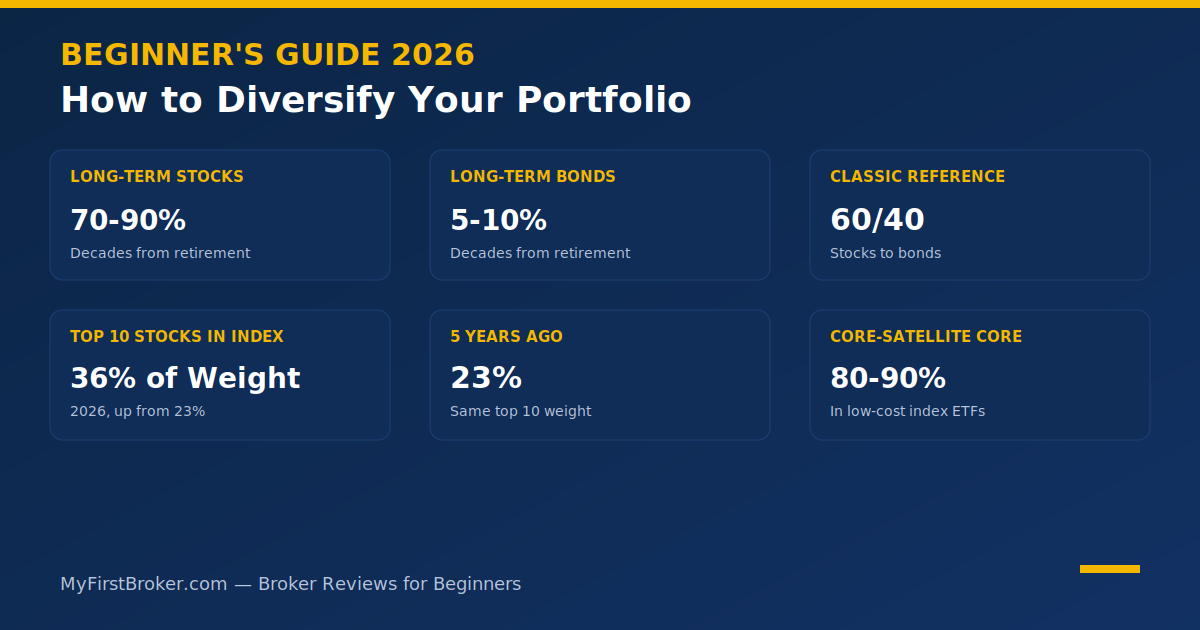
Diversification means spreading your investments across asset classes, sectors, and regions so that a decline in any one area doesn’t sink your entire portfolio. A simple starting point for beginners with a long time horizon is 70-90% in broad, low-cost stock ETFs and 5-10% in bonds, gradually shifting toward more bonds as retirement gets closer. A single S&P 500 index fund already gives you exposure to hundreds of companies, but true diversification also means not over-concentrating in one sector, like technology, even within a broad fund.
What Diversification Actually Means
Diversification isn’t just about owning multiple stocks — it’s about owning assets that don’t all move in the same direction at the same time. If everything in your portfolio tends to rise and fall together, you’re not truly diversified, even if you technically hold dozens of different positions.
A Simple Starting Allocation for Beginners
Decades from retirement: 70-90% stocks (broad ETFs), 5-10% bonds
Classic reference point: The traditional 60/40 stocks-to-bonds split
20 years from retirement: Bond allocation often rises to around 20%
Core holding: A broad, low-cost total market or S&P 500 ETF
The Hidden Concentration Risk in 2026
Even investors who own a single S&P 500 index fund may be less diversified than they think. The 10 largest companies in the U.S. market index now represent about 36% of its total weight, up from roughly 23% just five years ago — and most of that concentration is tied to a handful of technology companies. This doesn’t mean index investing is a bad idea; it means it’s worth being aware that “diversified” funds can still carry meaningful concentration in a few dominant names.
The Core-Satellite Approach
A common strategy for balancing simplicity with some flexibility is “core and satellite”: keep the majority of your portfolio (80-90%) in broad, low-cost index ETFs as your foundation, and use a smaller portion (10-20%) for individual stocks, sectors, or themes you want extra exposure to. This way, your overall results aren’t dependent on any single bet, while still letting you express specific views if you want to.
Don’t Forget Rebalancing
Over time, some parts of your portfolio will grow faster than others, quietly shifting your allocation away from your original plan. Periodically rebalancing — selling a bit of what’s grown and buying more of what hasn’t — helps keep your risk level consistent with your original intentions, rather than letting winners silently take over your portfolio.
Frequently Asked Questions
How many stocks do I need to be diversified?
Owning a single broad-market ETF, which holds hundreds or thousands of companies, already provides far more diversification than picking a handful of individual stocks yourself.
Should beginners own bonds?
Even a small bond allocation, such as 5-10%, can help diversify a portfolio for younger investors, though most of a long-term portfolio for someone decades from retirement is typically weighted toward stocks.
Is an S&P 500 index fund diversified enough?
It’s diversified across hundreds of companies, but be aware that its largest holdings are increasingly concentrated in a small number of technology companies, which is worth understanding even if it doesn’t change your strategy.
Is this guide on how to diversify your portfolio up to date?
Yes — this guide on how to diversify your portfolio is reviewed regularly and reflects current market concentration data as of 2026.
Learning how to diversify your portfolio properly is one of the simplest ways to reduce risk without sacrificing long-term growth potential.
Ready to build your core holdings? See our ETF vs Stocks guide and our guide to expense ratios for picking low-cost funds, or read Morningstar’s guide to portfolio diversification.