
What is compound interest? It’s the reason a modest, consistent investment can grow into a much larger sum than most people expect — because you don’t just earn returns on your original money, you earn returns on your returns too. Understanding this single concept is one of the most valuable things a beginner investor can learn.
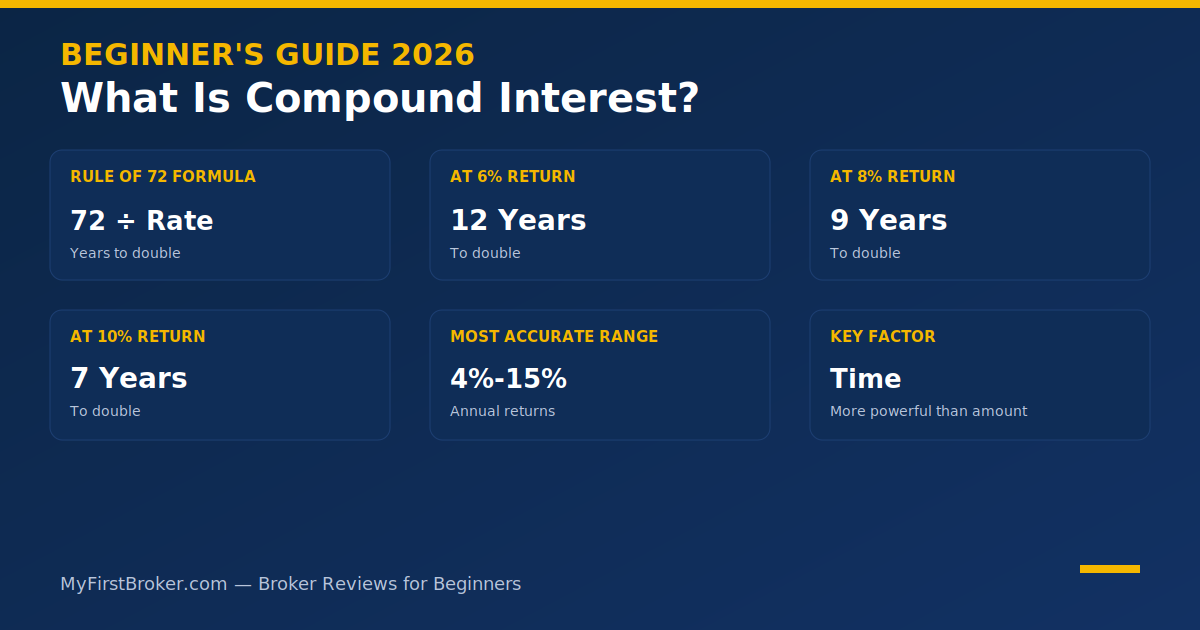
Compound interest means your investment earnings get added back to your balance and start generating their own returns — unlike simple interest, which only pays on your original principal. A simple mental shortcut called the Rule of 72 estimates how long it takes your money to double: just divide 72 by your annual rate of return. At 8% annually, for example, your money doubles roughly every 9 years.
Compounding Works Against You Too
The same mechanism that grows your investments can also work in reverse with debt. Credit card balances, for example, often compound at much higher rates than typical investment returns, which is why carrying high-interest debt tends to outweigh whatever gains you might earn by investing instead. Understanding compound interest isn’t just about growing wealth — it’s also about recognizing when it’s quietly working against you.
What Is Compound Interest and How Does It Work?
Compound interest is interest calculated on both your original principal and any interest that’s already accumulated. With simple interest, you only ever earn a return on your starting amount. With compound interest, each year’s gains become part of the balance that earns returns the following year — which is why growth accelerates over time rather than staying flat.
The Rule of 72: A Simple Way to Estimate Growth
At 6% annual return: Money doubles in about 12 years (72 ÷ 6)
At 8% annual return: Money doubles in about 9 years (72 ÷ 8)
At 10% annual return: Money doubles in about 7 years (72 ÷ 10)
Most accurate range: Between 4% and 15% annual returns
Why Starting Early Matters So Much
Because compound interest builds on itself, time is often more powerful than the amount you invest. Someone who starts investing a smaller amount in their 20s can end up with more money at retirement than someone who invests a larger amount starting in their 40s, simply because the earlier investor’s money has more years to compound. This is the core reason financial educators emphasize starting as early as possible, even with small amounts.
A Practical Example
Imagine investing $5,000 today at an 8% average annual return and never adding another dollar. Using the Rule of 72, that money would roughly double every 9 years — growing to about $10,000 in 9 years, $20,000 in 18 years, and $40,000 in 27 years. No additional contributions, no extra effort — just time and compounding doing the work. This is why financial educators consistently emphasize starting as early as possible, even with a small amount, rather than waiting until you can invest a larger sum.
Frequently Asked Questions
What is compound interest in simple terms?
It’s interest earned on both your original investment and any interest that’s already been added to it, which causes your money to grow at an increasing rate over time rather than a fixed amount each year.
Does compound interest apply to all investments?
It applies to investments that reinvest earnings, such as dividend reinvestment plans or interest-bearing accounts. Individual stock price appreciation isn’t “interest” in the traditional sense, but reinvested dividends and interest-bearing assets both benefit from compounding.
How accurate is the Rule of 72?
It’s most accurate for annual returns between 4% and 15%, with the best precision around 8%. Outside that range, it becomes a rougher estimate.
Is this compound interest guide up to date?
Yes — this compound interest guide is reviewed regularly and reflects current examples and figures as of 2026.
Ready to put compounding to work? See our guide to dollar-cost averaging and our guide on how much beginners should invest, or read the SEC’s official explanation of the power of compounding.
Once you understand what is compound interest and how it accelerates over time, the case for starting to invest today instead of waiting becomes hard to ignore.