
How much should beginners invest to start? The honest answer is: far less than most people assume. Thanks to $0 account minimums and fractional shares, you can start investing with as little as $1 — but how much actually makes sense depends less on a magic number and more on your emergency fund, your goals, and your budget.
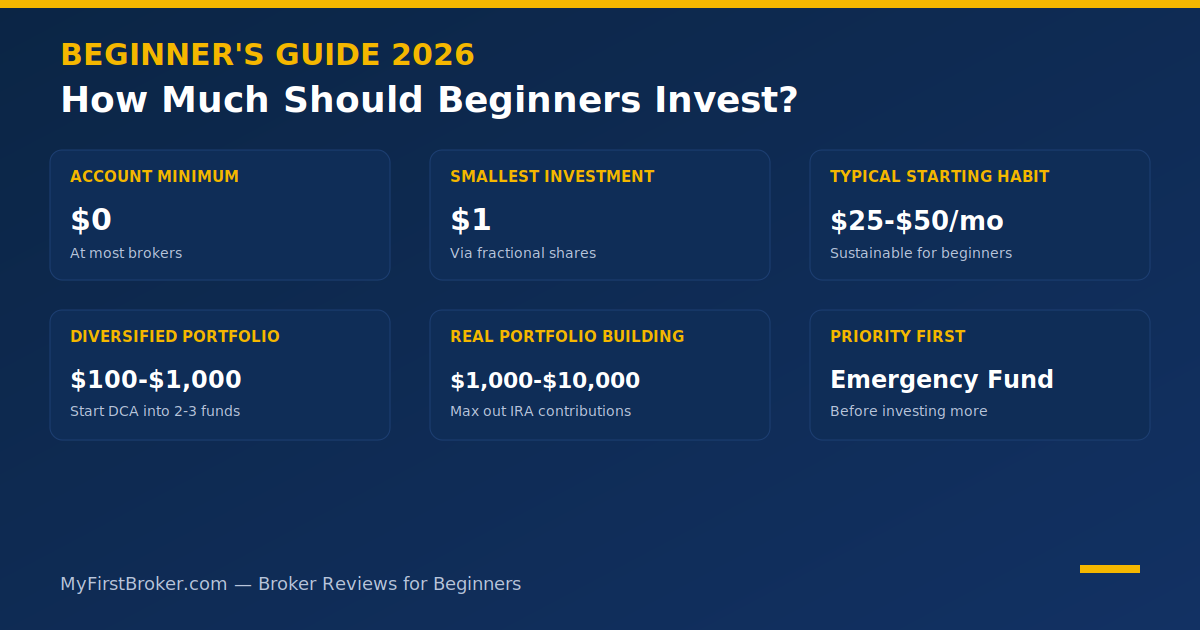
Most major brokers require $0 to open an account and let you buy fractional shares for as little as $1. But the more useful question isn’t the minimum — it’s how much you can invest consistently. A common approach: build an emergency fund first, then start with $25-$50 a month if that’s what fits your budget, gradually increasing as your income allows. The amount matters far less than starting the habit early and staying consistent.
How Much Should Beginners Invest? The Real Minimum
Account minimum: $0 at most major brokers (Fidelity, Schwab, Robinhood, Vanguard for ETFs)
Smallest possible investment: $1, thanks to fractional shares
Typical starting habit: $25-$50 per month for beginners on a tight budget
Where a diversified portfolio starts to make sense: $100-$1,000
Before You Invest Anything: The Emergency Fund Question
Most financial educators recommend having some cash set aside for emergencies before investing significant amounts — so an unexpected expense doesn’t force you to sell investments at a bad time. This doesn’t mean you need thousands saved before you start; it means balancing a small emergency cushion with starting your investing habit, rather than choosing one before the other entirely.
How Much to Invest at Different Starting Points
$1-$100: Just Start
At this level, the goal isn’t building a diversified portfolio — it’s building the habit. Buy a fractional share of a broad market ETF like an S&P 500 fund and get comfortable with the mechanics of investing.
$100-$1,000: Begin Dollar-Cost Averaging
Once you’re contributing regularly, this is a natural range to start dollar-cost averaging weekly or monthly into 2-3 low-cost index funds.
$1,000-$10,000: Build a Real Portfolio
At this stage, it’s worth building a more diversified three-fund style portfolio and prioritizing tax-advantaged accounts — maxing out IRA contributions if your budget allows before adding to a taxable account.
$10,000+
Consider diversifying further across asset classes and account types, and revisit whether your current broker’s fee structure still fits your larger balance.
Why the Amount Matters Less Than Consistency
Investing $50 a month starting today will very often outperform waiting until you have $5,000 saved up to start, simply because of how much longer your money has to grow. Compound growth rewards time in the market far more than it rewards a larger starting amount — this is one of the most consistent findings across long-term investing research.
When people ask how much should beginners invest, the honest answer is that consistency beats the exact number every time.
Frequently Asked Questions
Can I start investing with just $10?
Yes. Most major brokers have no account minimum and support fractional shares, so $10 is enough to buy a slice of nearly any stock or ETF.
Should I pay off debt before investing?
For high-interest debt like credit cards, many financial educators recommend prioritizing payoff first, since the interest rate often exceeds typical investment returns. Lower-interest debt is more of a personal judgment call.
How much should a beginner invest per month?
There’s no universal number — $25-$50 a month is a common, sustainable starting point for many beginners, with the amount increasing as income grows.
Is this guide on how much beginners should invest up to date?
Yes — this guide on how much beginners should invest is reviewed regularly and reflects current account minimums and industry practices as of 2026.
Whatever you decide, remember that how much should beginners invest matters less than staying consistent over time.
Ready to open your first account? See our Best Online Brokers for Beginners roundup and our step-by-step guide to opening a brokerage account, or read our guide to dollar-cost averaging for a strategy on investing consistently over time.
Figuring out how much should beginners invest matters far less than simply starting — even a small amount today beats waiting for the “right” number.
For more on building healthy financial habits before investing, see the CFPB’s official guide to money management.
There’s no perfect number for how much should beginners invest — what matters most is picking an amount you can sustain every month.