
What is an expense ratio? It’s the annual fee a mutual fund or ETF charges to manage your money, expressed as a percentage of your investment — and it’s one of the few costs in investing you can control completely, just by choosing the right fund. Understanding it can be the difference between keeping tens of thousands of extra dollars over your investing lifetime, or quietly losing them to fees you never see on a statement.
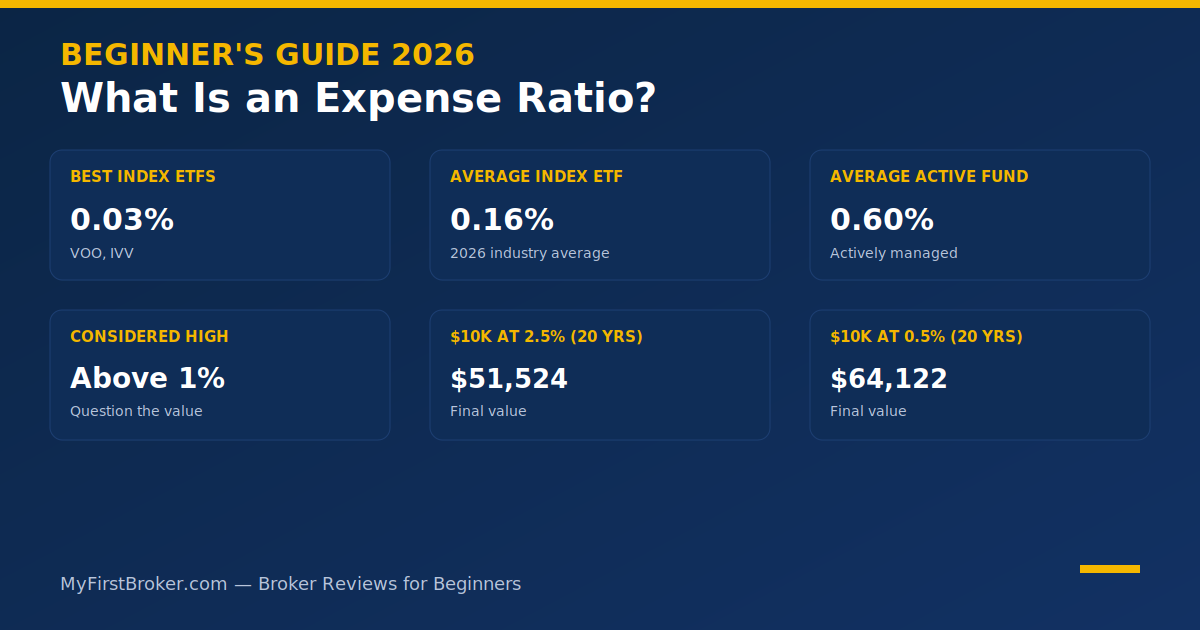
An expense ratio is the annual cost of owning a mutual fund or ETF, deducted automatically from the fund’s returns — you’ll never see a line item for it on your statement. In 2026, the average index ETF charges around 0.16%, while actively managed funds average closer to 0.60%. The cheapest S&P 500 ETFs, like VOO and IVV, charge just 0.03%. Over decades, even a small difference in expense ratio can cost you tens of thousands of dollars in lost growth.
What Is an Expense Ratio and How Does It Work?
An expense ratio covers a fund’s management fees and operating costs, expressed as a percentage of your investment per year. If a fund has a 0.50% expense ratio and you have $10,000 invested, you pay $50 a year — but you’ll never see a bill. The fee is deducted gradually from the fund’s net asset value every trading day, quietly reducing your returns without ever showing up as a separate charge.
What’s a Good Expense Ratio in 2026?
Best index ETFs: 0.03%-0.05% (e.g., VOO, IVV)
Average index ETF: Around 0.16%
Average actively managed fund: Around 0.60%
Considered high: Above 1%
Almost always too expensive: Above 1.5%
Why a Small Percentage Makes Such a Big Difference
Expense ratios compound the same way your investment returns do — except in reverse, working against you every year. On a $10,000 investment held for 20 years, a fund charging 2.5% would grow to roughly $51,524, while the same investment in a fund charging just 0.5% would grow to about $64,122 — a difference of over $12,000 from the fee alone, assuming identical underlying performance. The gap only grows wider over longer time horizons or larger account balances.
Understanding what is an expense ratio can save you thousands of dollars over a long investing career, simply by choosing lower-cost funds.
How to Check a Fund’s Expense Ratio
Every fund publishes its expense ratio in its prospectus, and most brokers display it directly on the fund’s page before you buy. As a simple rule: for passive index funds, look for 0.03%-0.20%; for actively managed funds, question anything meaningfully above 0.75%, since a low expense ratio doesn’t guarantee good returns — it just means more of the fund’s gains stay in your pocket instead of going to the fund company.
Frequently Asked Questions
Is a 0% expense ratio possible?
Yes — a small number of funds, including some from Fidelity, charge a 0% expense ratio, though most index funds still charge a small amount, typically 0.03%-0.20%.
Do I pay the expense ratio directly?
No, not as a separate bill. It’s deducted automatically from the fund’s assets daily, which lowers your returns without appearing as a distinct charge on your account.
Does a lower expense ratio always mean better returns?
Not automatically — but it does guarantee you keep more of whatever the fund earns. Two funds tracking the same index with similar performance will show a real difference in your final returns based purely on their expense ratios.
Is this expense ratio guide up to date?
Yes — this expense ratio guide is reviewed regularly and reflects current industry averages and figures as of 2026.
Ready to compare low-cost fund options? See our ETF vs Stocks guide and our Vanguard review, or read the SEC’s official guide to how fees affect your investment portfolio.
Now that you know what is an expense ratio and how it compounds against you, comparing this single number before buying any fund is always worth the extra minute.