
What is tax loss harvesting? It’s the strategy of selling an investment at a loss on purpose, so you can use that loss to reduce your tax bill — turning a losing position into a genuine financial benefit. It sounds counterintuitive, but it’s one of the few legal ways ordinary investors can lower what they owe the IRS every year.
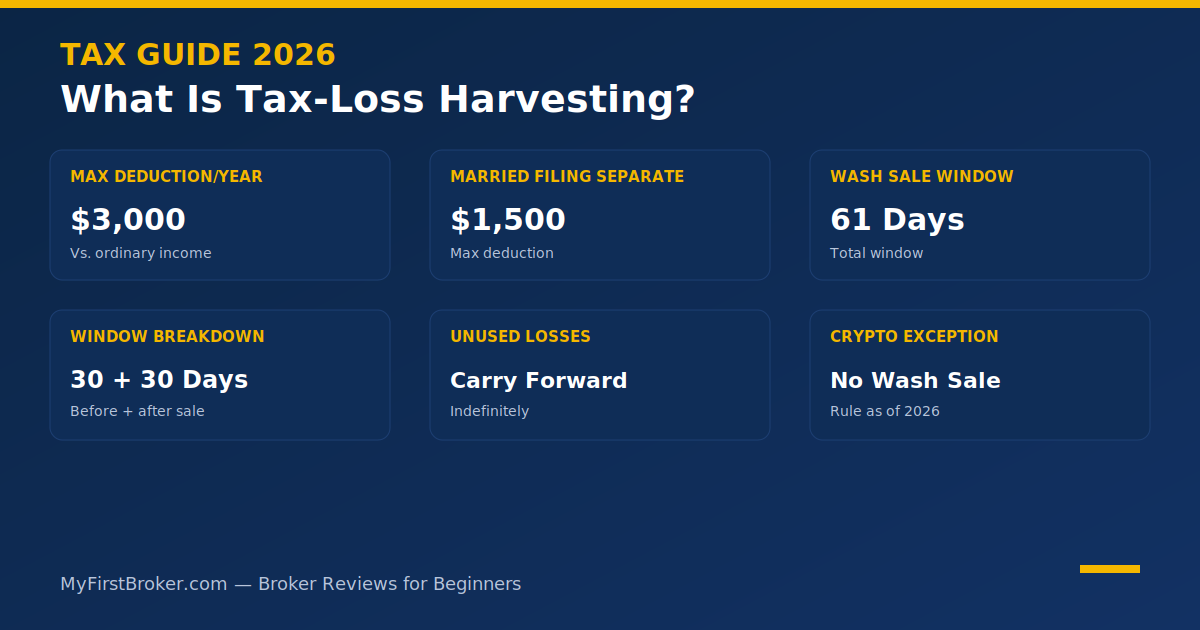
Tax-loss harvesting means selling an investment at a loss to offset capital gains elsewhere in your portfolio, reducing your tax bill. If your losses exceed your gains, you can deduct up to $3,000 against ordinary income per year, with any remainder carried forward indefinitely. The biggest rule to watch for is the “wash sale” rule: if you buy back a substantially identical security within 30 days before or after the sale, the loss is disallowed.
What Is Tax Loss Harvesting and How Does It Work?
Capital losses first offset capital gains dollar-for-dollar with no limit — short-term losses against short-term gains, long-term against long-term, with any leftover crossing over between the two categories. If your total losses still exceed your gains after that, you can deduct up to $3,000 of the excess against your ordinary income each year ($1,500 if married filing separately), and any remaining loss carries forward to future tax years indefinitely.
Understanding what is tax loss harvesting can meaningfully reduce what you owe the IRS, especially in years with significant investment losses.
The Wash Sale Rule: What to Avoid
Wash sale window: 30 days before and 30 days after the sale (61 days total)
What triggers it: Buying a “substantially identical” security within that window
Applies across: All your accounts, including your spouse’s
Crypto exception: Not currently subject to the wash sale rule, as of 2026
A Simple Example
Say you have $10,000 in short-term capital losses, plus $4,000 in short-term gains and $5,000 in long-term gains elsewhere. First, your short-term losses offset your short-term gains ($10,000 loss – $4,000 gain = $6,000 remaining loss). That remaining $6,000 then crosses over to offset your $5,000 long-term gain, wiping it out entirely and leaving you with a final $1,000 net loss for the year — which can then reduce your ordinary income.
Tax loss harvesting works best as an ongoing habit rather than a once-a-year scramble in December. Reviewing your portfolio periodically throughout the year lets you act on market dips as they happen, rather than competing with every other investor trying to harvest losses in the final weeks before year-end.
How to Avoid Accidentally Triggering a Wash Sale
The safest approach is to wait at least 31 days before repurchasing the same security, or swap into a similar-but-not-identical fund in the same asset class — for example, moving from one S&P 500 ETF into a different one tracking a distinct index — so you stay invested in the market while avoiding the wash sale rule.
Frequently Asked Questions
How much can I deduct from tax-loss harvesting each year?
If your losses exceed your gains, you can deduct up to $3,000 against ordinary income per year ($1,500 if married filing separately), with any excess carried forward to future years.
What triggers the wash sale rule?
Buying a “substantially identical” security within 30 days before or after selling at a loss. This applies across all your accounts, including a spouse’s.
Does tax-loss harvesting apply to cryptocurrency?
As of 2026, cryptocurrency is not subject to the wash sale rule, meaning you can sell crypto at a loss and immediately repurchase it — though this rule could change with future legislation.
Is this tax-loss harvesting guide up to date?
Yes — this tax-loss harvesting guide is reviewed regularly and reflects current IRS rules and limits as of 2026.
Now that you know what is tax loss harvesting, reviewing your portfolio for opportunities a few times a year — not just in December — can help you capture more value from it.
Ready to review your portfolio? See our guide to diversifying your portfolio and our guide to expense ratios, or read the IRS’s official guidance on capital gains and losses.