
What is a 401k? It’s the retirement account most Americans have access to through their employer, and for many beginners, it’s the very first investment account they’ll ever open — often without even realizing free money is on the table. Understanding how a 401k works, and whether you’re leaving employer money unclaimed, can be one of the highest-value financial moves you make early in your career.
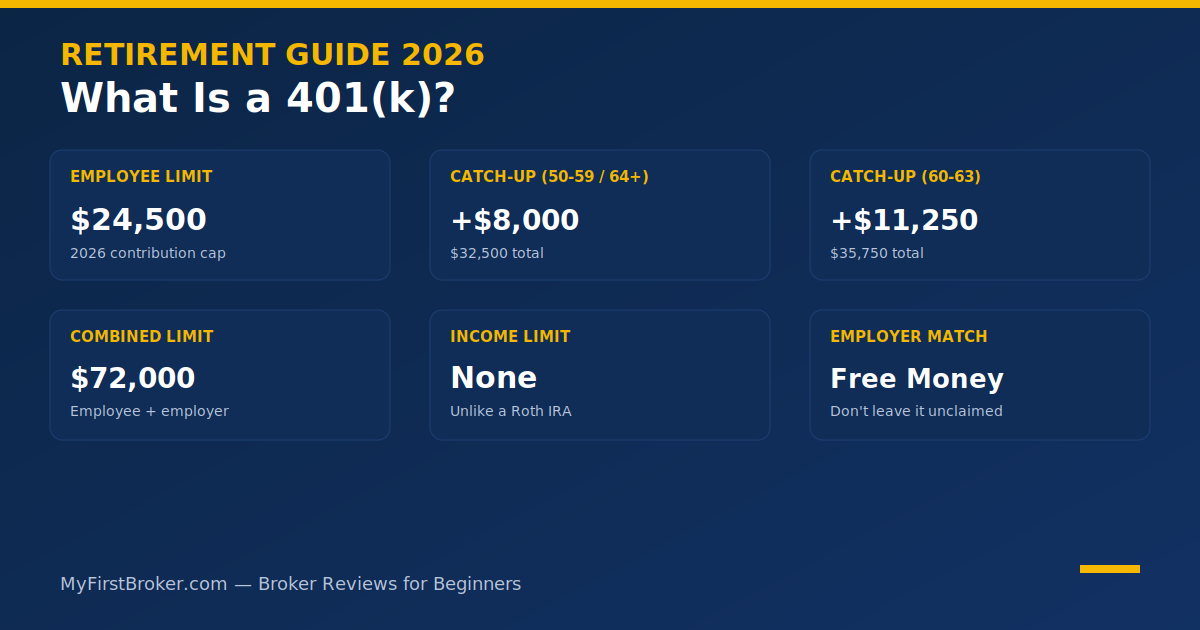
A 401(k) is an employer-sponsored retirement account that lets you contribute part of your paycheck before or after taxes, often with an employer match. In 2026, you can contribute up to $24,500 as an employee, with an $8,000 catch-up if you’re 50+ (or $11,250 if you’re 60-63). Unlike a Roth IRA, there’s no income limit to contribute. If your employer offers a match, contributing enough to capture the full match is essentially free money you shouldn’t leave unclaimed.
What Is a 401k and How Does It Work?
A 401(k) is a retirement savings plan sponsored by your employer. Money is deducted directly from your paycheck and invested — typically in a menu of mutual funds or target-date funds your employer’s plan offers. Many employers also contribute a “match”: extra money added to your account based on how much you contribute yourself, up to a certain percentage of your salary.
2026 401(k) Contribution Limits
Employee contribution limit: $24,500
Catch-up (age 50-59 or 64+): Additional $8,000 ($32,500 total)
Catch-up (age 60-63): Additional $11,250 ($35,750 total)
Combined limit (employee + employer): $72,000
Income limit to contribute: None — unlike a Roth IRA
Why the Employer Match Matters So Much
A common matching formula is something like 50 cents on the dollar up to 6% of your salary. If you earn $60,000 and contribute 6% ($3,600), your employer might add another $1,800 — money you wouldn’t otherwise get, and it’s not counted against your own $24,500 contribution limit. Skipping this match because you’re not contributing enough is one of the most common ways beginners leave free money unclaimed early in their careers.
Traditional 401(k) vs Roth 401(k)
Many employers now offer both options. A Traditional 401(k) uses pre-tax dollars, lowering your taxable income now, with taxes owed on withdrawals in retirement. A Roth 401(k) uses after-tax dollars, with no deduction now but tax-free qualified withdrawals later — similar to the Roth vs Traditional IRA tradeoff, but through your employer’s plan and without any income limit restricting who can use it.
401(k) vs IRA: What’s the Difference?
A 401(k) is employer-sponsored with a much higher contribution limit ($24,500 vs $7,500 for an IRA) and often includes a match. An IRA is opened independently through a broker, with more investment choices but a lower contribution limit. Contributing to a 401(k) doesn’t reduce how much you can put into an IRA — you can max out both in the same year if your budget allows.
Now that you know what is a 401k and how it compares to an IRA, you’re better equipped to decide how to split your retirement contributions.
Frequently Asked Questions
How much should I contribute to my 401(k) as a beginner?
At minimum, contribute enough to capture your full employer match — that’s an immediate, guaranteed return you shouldn’t skip. Beyond that, contributing more depends on your budget and other financial goals.
What happens to my 401(k) if I change jobs?
You can typically roll it over into your new employer’s 401(k) or into an IRA without triggering taxes, as long as it’s done as a direct rollover.
Is there an income limit to contribute to a 401(k)?
No. Unlike a Roth IRA, there’s no income limit that restricts who can contribute to a 401(k), which is one of its biggest advantages for higher earners.
Is this 401(k) guide up to date?
Yes — this 401(k) guide is reviewed regularly and reflects current IRS contribution limits and rules as of 2026.
Understanding what is a 401k and how the employer match works can be one of the simplest ways to boost your retirement savings without any extra effort.
Want to compare it to other retirement accounts? Read our guide to Roth IRAs and our Traditional IRA vs Roth IRA comparison, or see the IRS’s official 401(k) plans overview.