
Traditional IRA vs Roth IRA is one of the most common retirement questions beginners face, and the honest answer is: it depends on when you’d rather pay taxes. Both accounts share the same 2026 contribution limit, but they work in almost opposite ways — and picking the right one now can meaningfully change how much money you keep in retirement.
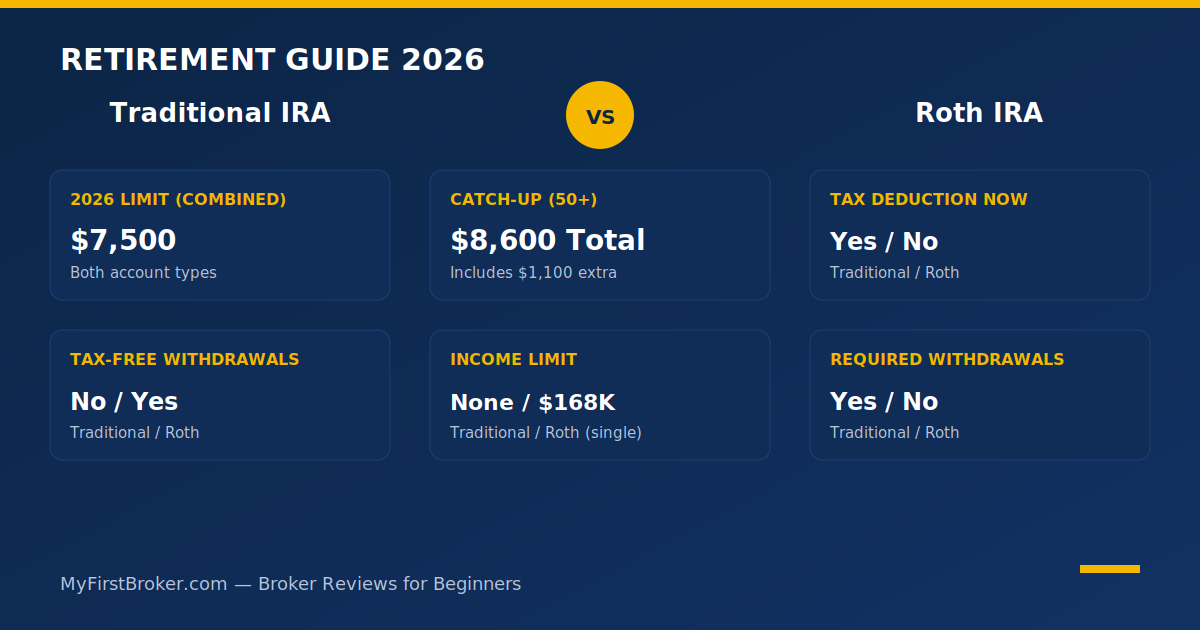
A Traditional IRA gives you a tax deduction now, with taxes owed later when you withdraw in retirement. A Roth IRA gives you no deduction now, but qualified withdrawals in retirement are completely tax-free. Both share the same 2026 contribution limit of $7,500 ($8,600 if you’re 50+). If you expect to be in a lower tax bracket in retirement than you are today, Traditional often wins. If you expect a similar or higher tax bracket later — common for younger beginners early in their careers — Roth usually wins.
Traditional IRA vs Roth IRA at a Glance
2026 contribution limit: $7,500 combined across both account types ($8,600 if 50+)
Tax treatment now: Traditional may be tax-deductible; Roth contributions are never deductible
Tax treatment later: Traditional withdrawals are taxed as income; Roth qualified withdrawals are tax-free
Income limits to contribute: None for Traditional; Roth phases out at $153,000-$168,000 (single) or $242,000-$252,000 (married)
Required withdrawals: Traditional IRAs have required minimum distributions later in life; Roth IRAs do not for the original owner
How a Traditional IRA Works
A Traditional IRA lets anyone with earned income contribute, regardless of how much they make. Depending on your income and whether you (or your spouse) have access to a workplace retirement plan, your contribution may be tax-deductible — reducing your taxable income for the year you contribute. In exchange, you’ll owe ordinary income tax on the money when you withdraw it in retirement.
How a Roth IRA Works
A Roth IRA works in reverse: you contribute money you’ve already paid taxes on, so there’s no deduction today. But qualified withdrawals in retirement — both your contributions and any growth — are completely tax-free. The tradeoff is that Roth IRAs have income limits: if you earn too much, you can’t contribute directly (though a “backdoor Roth” strategy exists as a workaround).
Which One Should You Choose?
The simplest way to decide: if you think your tax rate will be lower in retirement than it is right now, a Traditional IRA’s upfront deduction is usually worth more. If you think your tax rate will be the same or higher later — which is common for beginners early in their careers, since income (and tax rates) tend to rise over time — a Roth IRA’s tax-free withdrawals usually come out ahead. Many people split the difference and contribute to both over time, since the $7,500 limit is combined either way.
Traditional IRA Pros
- Possible tax deduction the year you contribute
- No income limit to contribute
- Lowers your taxable income now
Traditional IRA Cons
- Withdrawals taxed as ordinary income in retirement
- Required minimum distributions later in life
- Deduction may be limited if you have a workplace plan
Roth IRA Pros
- Tax-free qualified withdrawals in retirement
- No required minimum distributions for the original owner
- Contributions (not earnings) can be withdrawn anytime, tax-free
Roth IRA Cons
- No tax deduction today
- Income limits restrict who can contribute directly
Frequently Asked Questions
Can I contribute to both a Traditional IRA and a Roth IRA?
Yes, but your combined contributions across both accounts can’t exceed the annual limit — $7,500 in 2026, or $8,600 if you’re 50 or older.
Which is better for beginners, Traditional or Roth IRA?
Many financial educators lean toward Roth IRAs for younger beginners, since their current tax rate is often lower than what they’ll pay later in higher-earning years. But the right choice depends on your individual income and expectations for retirement.
What happens if I earn too much for a Roth IRA?
If your income exceeds the Roth phase-out range, you can still contribute to a Traditional IRA regardless of income, or explore a backdoor Roth conversion with guidance from a tax professional.
Is this Traditional IRA vs Roth IRA guide up to date?
Yes — this Traditional IRA vs Roth IRA guide is reviewed regularly and reflects current IRS contribution limits and income thresholds as of 2026.
Want to go deeper on Roth accounts specifically? Read our full guide to Roth IRAs, or see our Fidelity Investments review and Vanguard review for two popular places to open either account. For official rules, see the IRS’s retirement topics page on IRA contribution limits.