
What is a Roth IRA? It’s a retirement account that lets your investments grow completely tax-free — you pay taxes on the money going in, not on the growth or withdrawals in retirement. For beginners deciding where to put their first long-term investment, understanding how a Roth IRA works can mean the difference between paying taxes twice or never again on your gains.
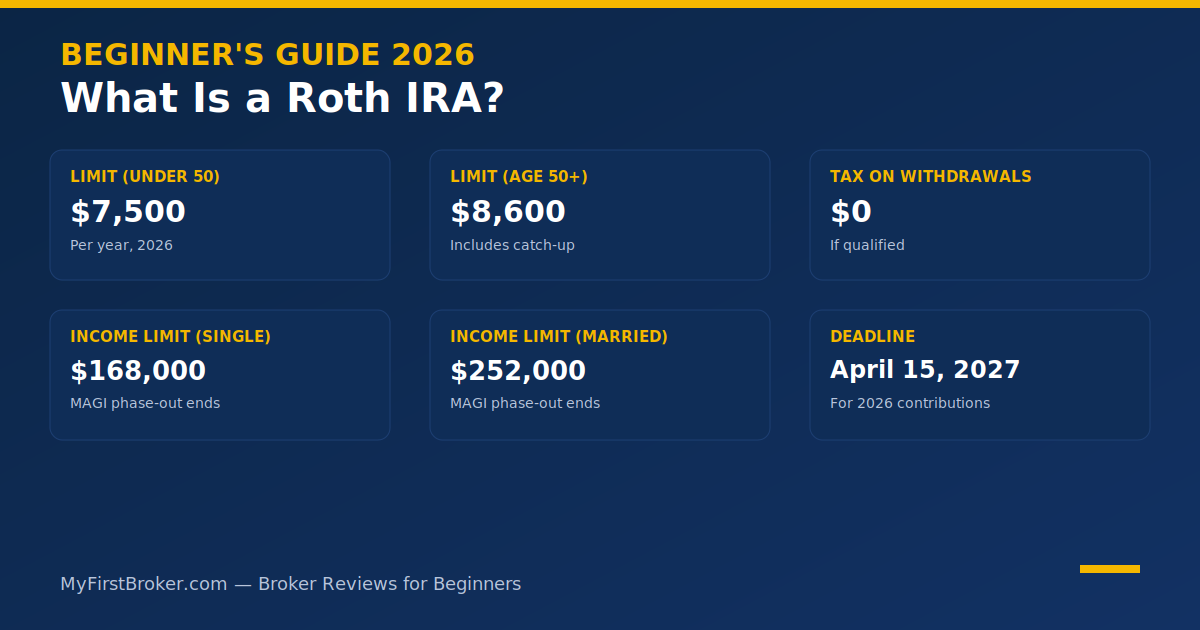
A Roth IRA is a retirement account funded with after-tax dollars. In 2026, you can contribute up to $7,500 ($8,600 if you’re 50+), and your investments grow and can be withdrawn tax-free in retirement, as long as you follow the rules. Income limits apply: single filers earning over $168,000 MAGI and married couples filing jointly earning over $252,000 MAGI can’t contribute directly.
What Is a Roth IRA and How Does It Work?
Unlike a Traditional IRA, where contributions are tax-deductible now and taxed on withdrawal, a Roth IRA works the opposite way. You contribute money you’ve already paid income tax on, and in exchange, the IRS never taxes it again — not the growth, not the withdrawals, as long as you follow the rules. That makes a Roth IRA especially valuable for beginners early in their career, when their tax rate is likely lower than it will be later in life.
2026 Roth IRA Contribution Limits
Under age 50: $7,500 per year
Age 50 and older: $8,600 per year (includes $1,100 catch-up contribution)
Contribution deadline: April 15, 2027 for the 2026 tax year
Combined limit: Shared across all your IRAs — Traditional and Roth combined
Income Limits: Can You Contribute?
Roth IRA eligibility depends on your Modified Adjusted Gross Income (MAGI). For 2026:
- Single or head of household: Full contribution allowed under $153,000 MAGI. Phases out between $153,000 and $168,000. No direct contribution above $168,000.
- Married filing jointly: Full contribution allowed under $242,000 MAGI. Phases out between $242,000 and $252,000. No direct contribution above $252,000.
If your income is too high for a direct contribution, a “backdoor Roth IRA” — contributing to a Traditional IRA and converting it — is a common workaround, though it has its own tax considerations worth discussing with a tax professional.
Roth IRA vs Traditional IRA: The Key Difference
The simplest way to think about it: a Traditional IRA taxes you later, a Roth IRA taxes you now. If you expect to be in a higher tax bracket in retirement than you are today — common for younger beginners early in their careers — a Roth IRA is usually the better deal, since you lock in today’s lower tax rate instead of paying more later.
How to Open a Roth IRA
- Choose a broker that offers Roth IRAs (most major brokers do, including Fidelity, Vanguard, and Robinhood).
- Confirm your earned income meets or exceeds your planned contribution.
- Open the account online, providing your Social Security number and employment details.
- Fund the account via bank transfer, up to the annual limit.
- Choose your investments — a low-cost index fund or ETF is a common starting point for beginners.
Frequently Asked Questions
What is a Roth IRA in simple terms?
A Roth IRA is a retirement account funded with money you’ve already paid taxes on. In exchange, your investments grow tax-free and qualified withdrawals in retirement are also tax-free.
What happens if I contribute too much to a Roth IRA?
Excess contributions are subject to a 6% penalty for each year the excess amount remains in the account, so it’s important to correct an overcontribution before your tax filing deadline.
Can I withdraw money from a Roth IRA before retirement?
You can withdraw your original contributions (not earnings) at any time without taxes or penalties, since you already paid tax on that money. Withdrawing earnings early generally triggers taxes and a 10% penalty, with some exceptions.
Is this Roth IRA guide up to date?
Yes — this Roth IRA guide is reviewed regularly and reflects current IRS contribution limits and income thresholds as of 2026.
Ready to open one? See our Fidelity Investments review and Vanguard review for two of the most popular places to open a Roth IRA, or read the IRS’s official 2026 retirement contribution limits announcement.
Understanding what is a Roth IRA and how its tax rules work is one of the most valuable things a beginner investor can learn early on.