
Vanguard vs Robinhood pits the company that pioneered low-cost index investing against the app that pioneered commission-free trading. Both charge $0 for stock and ETF trades, but the real differences show up in fund costs, account fees, and how each broker treats your uninvested cash.
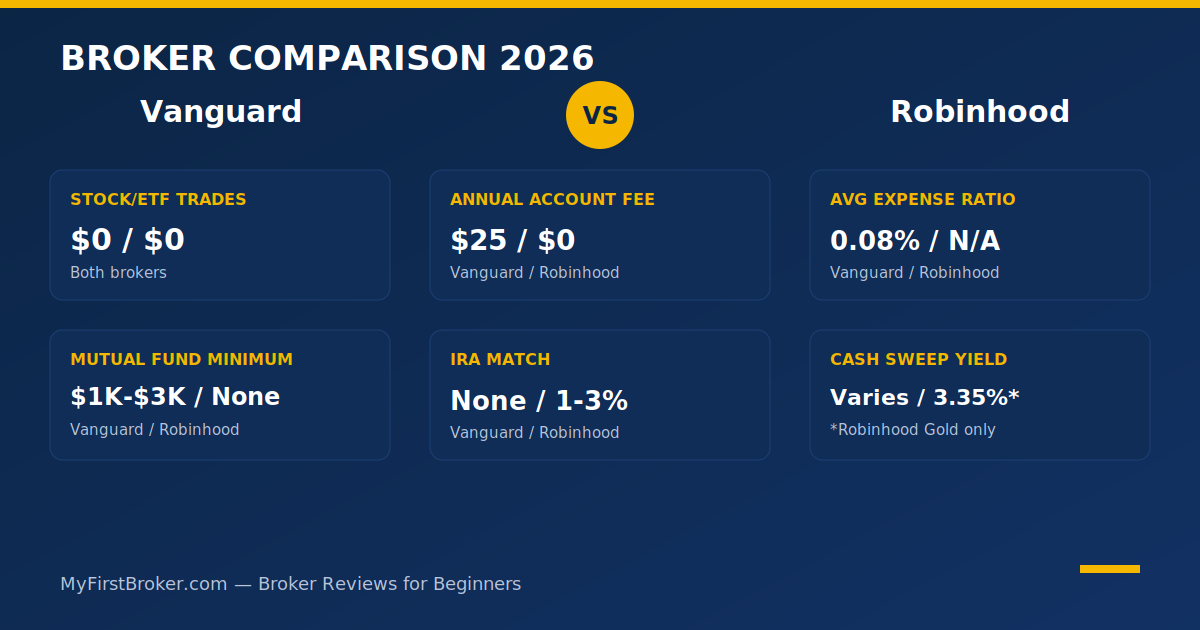
Both brokers charge $0 for stock and ETF trades with no account minimum to open. Vanguard edges ahead for long-term investors thanks to industry-leading low expense ratios averaging 0.08%, though it charges a $25 annual account fee (waivable) and requires $1,000-$3,000 for some mutual funds. Robinhood edges ahead for beginners with less capital and those who want an IRA match or a simpler mobile experience. If you’re investing a lump sum in low-cost funds for the long term, Vanguard remains excellent. If you want a simpler app with no fund minimums, Robinhood fits better.
Vanguard vs Robinhood at a Glance
Stock/ETF commissions: $0 at both brokers
Account minimum: $0 to open at both brokers
Annual account fee: $25 at Vanguard (waivable) vs $0 at Robinhood
Average fund expense ratio: ~0.08% at Vanguard vs the ~0.44% industry average
Mutual fund minimum: $1,000-$3,000 at Vanguard vs none offered at Robinhood
IRA match: None at Vanguard vs 1-3% at Robinhood
Vanguard vs Robinhood: Costs and Fees Breakdown
Both charge $0 for online stock and ETF trades. Vanguard charges a $25 annual account fee, though it’s easy to waive by signing up for electronic document delivery. Vanguard’s real advantage is its fund lineup — the firm’s average expense ratio is around 0.08%, dramatically lower than the roughly 0.44% industry average. Robinhood doesn’t offer mutual funds at all, so this comparison mostly matters if you specifically want Vanguard’s fund lineup.
Where Vanguard Wins
Vanguard’s core strength remains fund quality. With over a decade of leadership in low-cost index investing, its expense ratios are difficult to beat, and its lineup of retirement-focused funds is extensive. For investors ready to commit a lump sum to a long-term, diversified fund, Vanguard remains one of the strongest options in the industry.
Where Robinhood Wins
Robinhood’s advantage is simplicity and accessibility. There’s no fund minimum standing in your way, and Robinhood Gold’s IRA match (up to 3%) is a distinctive perk Vanguard doesn’t offer. Robinhood’s mobile-first app is also generally easier for beginners to navigate than Vanguard’s platform. Still torn on Vanguard vs Robinhood? If you’re investing a larger sum in low-cost index funds, Vanguard is hard to beat; if you’re starting smaller and want simplicity plus an IRA match, Robinhood fits better.
Vanguard Pros
- Industry-leading low expense ratios
- Deep lineup of retirement-focused funds
- Strong long-term reputation for index investing
Vanguard Cons
- $25 annual account fee (unless waived)
- $1,000-$3,000 minimums on some mutual funds
- No IRA match
Robinhood Pros
- No account minimums or fund minimums
- IRA match through Robinhood Gold
- Simple, beginner-friendly mobile app
Robinhood Cons
- No mutual funds offered
- Uninvested cash earns nothing without Gold
- $75 fee to transfer your account out
Frequently Asked Questions
Is Vanguard or Robinhood better for beginners?
Robinhood is generally simpler for beginners starting with less money, thanks to no fund minimums. Vanguard is a strong choice once you have enough to meet its mutual fund minimums and want industry-leading low fees.
Does Robinhood or Vanguard pay interest on uninvested cash?
Robinhood pays 3.35% APY on uninvested cash, but only for Robinhood Gold subscribers ($5/month). Standard Robinhood accounts earn nothing on idle cash.
Can I buy Vanguard funds through Robinhood?
Robinhood doesn’t offer Vanguard’s mutual funds, but many of Vanguard’s popular ETFs, like VOO and VTI, trade commission-free on Robinhood just like any other ETF.
Is this Vanguard vs Robinhood comparison up to date?
Yes — this Vanguard vs Robinhood comparison is reviewed regularly and reflects current fees and features as of 2026.
For more, read our full Vanguard review and Robinhood review, or see our Vanguard vs Fidelity comparison for another angle on Vanguard’s strengths.
For an unbiased overview of investor protections, see the SEC’s official guide to opening a brokerage account at Investor.gov.