
Looking for an honest Charles Schwab review before opening an account? Schwab is one of the oldest names in the discount brokerage world, and in 2026 it still competes directly with Fidelity for beginners who want a full-service platform with no fees getting in the way. This review breaks down what Schwab actually charges, what you get for it, and who it fits best.
Charles Schwab is a strong choice for beginners who want a large, established broker with no account minimums, $0 commissions, excellent customer service, and access to physical branches. It’s especially strong for retirement accounts and buy-and-hold investors. The main trade-off is a low interest rate on uninvested cash compared to some competitors.
Open a Schwab Account →
Opening an account is free. MyFirstBroker may earn a commission if you sign up through this link.
Charles Schwab at a Glance
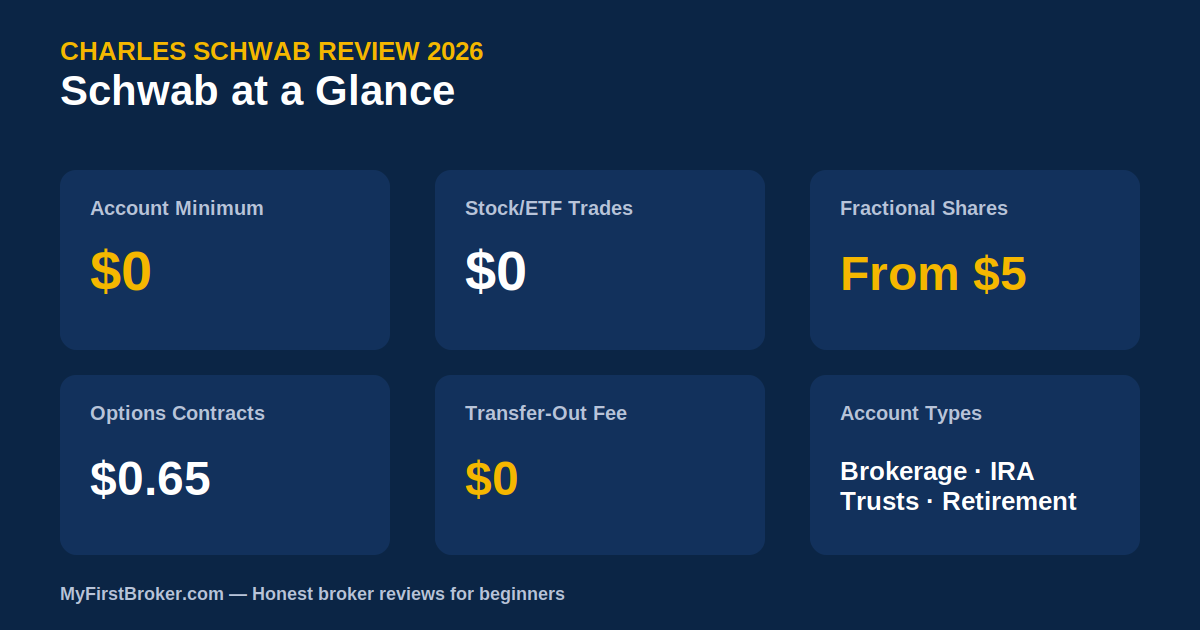
- Account Minimum$0
- Stock/ETF Trades$0 commission
- Options Contracts$0.65 per contract
- Fractional Shares✓ Yes, from $5 (Stock Slices)
- Account TypesBrokerage, Roth & Traditional IRA, Trusts, Retirement Plans
- Non-OneSource Mutual Fund Fee$49.95 per transaction
- Broker-Assisted Trade Fee$25
- Outgoing Transfer (ACAT) Fee$0
Charles Schwab Review: How Much Does It Actually Cost?
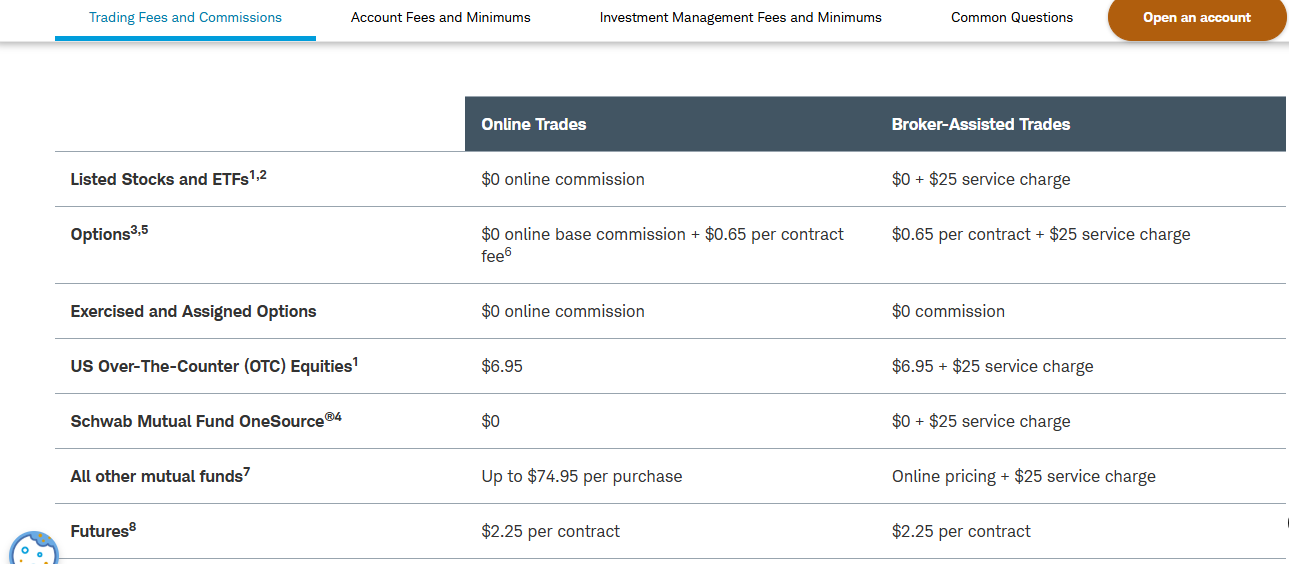
This Charles Schwab review found pricing very close to Fidelity’s: $0 commissions on online US stock and ETF trades, no account minimum, and no annual maintenance fee across brokerage accounts, IRAs, trusts, and retirement plans. Schwab also doesn’t charge inactivity fees, so an account you rarely trade in won’t cost you anything extra.
Where costs can appear:
- Non-OneSource mutual funds: Funds outside Schwab’s no-transaction-fee list cost $49.95 per purchase.
- Options contracts: $0.65 per contract, in line with the industry standard.
- Broker-assisted trades: $25 to place a trade over the phone with a representative, versus free online.
- Outgoing domestic wire: $25 per wire transfer. ACH transfers remain free.
For the complete, most current breakdown, you can always check Schwab’s official pricing guide.
One standout detail: Schwab charges $0 for outgoing account transfers (ACAT), meaning you won’t be penalized if you ever decide to move your portfolio to a different broker — unlike several competitors that charge $75–$100 for the same thing.
Account Types Available
Schwab covers nearly the same ground as Fidelity when it comes to account variety:
- Brokerage Account: Standard taxable account for general investing.
- Roth & Traditional IRA: Both available with $0 minimums.
- Trusts: Accounts for estate planning purposes.
- Retirement Plans: Including options for small business owners (SEP IRA, Solo 401(k)).
Pros and Cons
✓ Pros
- No account minimums or annual fees
- $0 commissions on stocks and ETFs
- $0 fee to transfer your account elsewhere (ACAT)
- Large selection of no-transaction-fee mutual funds
- Strong retirement planning tools and research
- Access to physical branches and phone support
✗ Cons
- $49.95 fee on non-OneSource mutual funds
- Low interest rate on uninvested cash compared to some competitors
- Stock Slices fractional investing limited to S&P 500 companies
- Mobile app experience trails some newer, app-first competitors
Who Is Charles Schwab Best For?
Schwab is a strong fit for beginners who want the reassurance of a large, established institution — with in-person branches and phone support — while still paying nothing in commissions or account fees. It’s particularly well suited for retirement-focused investors thanks to its broad account options and no-transaction-fee fund selection.
How Does Schwab Compare to Other Brokers?
Curious how Schwab stacks up against other options? See our head-to-head comparisons: Schwab vs Fidelity, Schwab vs Vanguard, Schwab vs Robinhood, and Schwab vs SoFi.
If your priority is the simplest possible mobile experience, Robinhood may feel more approachable at first. But for beginners planning to eventually need retirement accounts, trusts, or in-person guidance, Schwab’s broader account lineup gives it an edge over app-first brokers.
How to Open a Charles Schwab Account
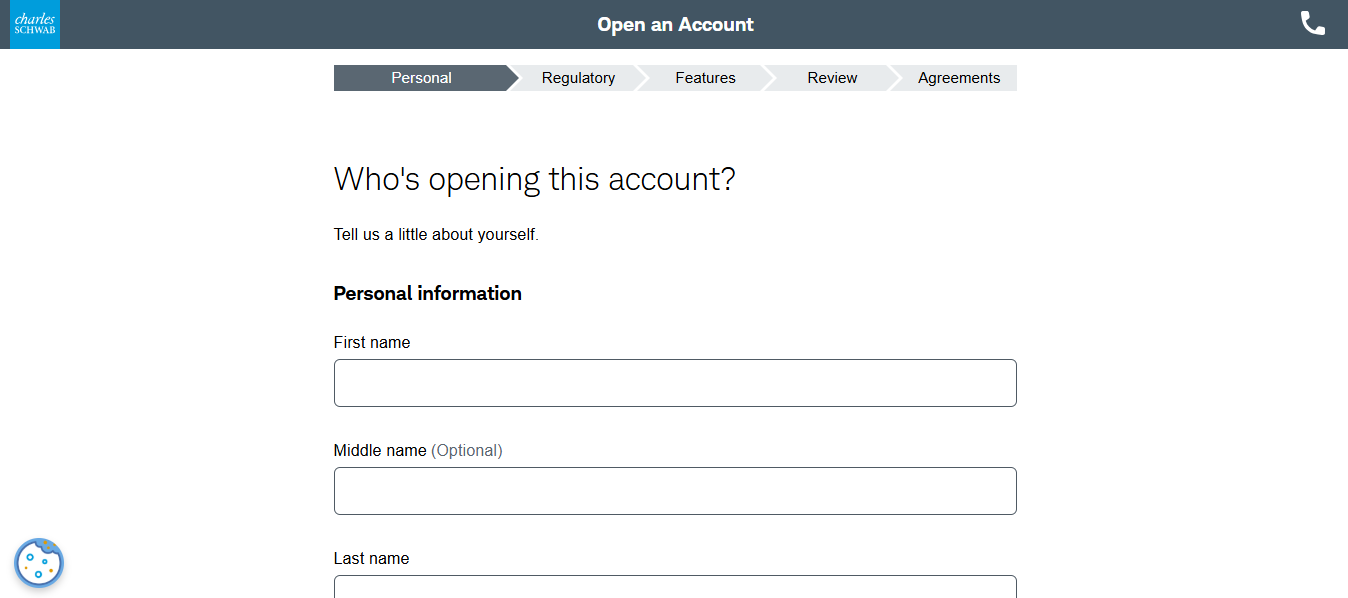
- Go to Schwab’s website and select “Open an Account.”
- Choose your account type — a brokerage account or Roth IRA are common starting points for beginners.
- Enter your personal information — name, address, Social Security number, and employment details.
- Link your bank account via ACH transfer to fund it.
- Make your first investment — many beginners start with a broad-market ETF or use Stock Slices to buy fractional shares of individual companies.
Frequently Asked Questions
Does Charles Schwab have a minimum deposit?
No. Standard brokerage accounts, IRAs, trusts, and retirement plans all have a $0 minimum to open.
Does Schwab charge inactivity fees?
No. Schwab does not charge inactivity fees, even if your account sits untouched for months.
Is it expensive to leave Charles Schwab?
No — Schwab charges $0 for outgoing account transfers (ACAT), so you can move your portfolio to another broker without a penalty fee.
Is this Charles Schwab review up to date?
Yes. This Charles Schwab review reflects fees and features confirmed as of mid-2026. Fee schedules can change, so always confirm current details in Schwab’s official Pricing Guide before opening an account.
Want to see how Schwab compares to other platforms? Read our Fidelity Investments review, our Robinhood review, or check the full comparison of the best online brokers for beginners in 2026.
For an unbiased overview of investor protections, see the SEC’s official guide to opening a brokerage account at Investor.gov.
Open a Schwab Account →
Opening an account is free. MyFirstBroker may earn a commission if you sign up through this link.